v1.1 Cheat Sheet
Sequence → physicochemical scales → interpretable features → explainable ML → biological mechanism
pip install aaanalysis · aaanalysis.readthedocs.io
AAanalysis is a Python framework for interpretable, sequence-based protein prediction. It turns sequences into physicochemical features (CPP), trains explainable models, and traces every prediction back to a residue × property × group comparison — robust for small datasets. v1.1 extends the core feature engine beyond physicochemical scales to PLM embeddings and protein structure.
Install · Import · Loadcore + [pro]
# Python >= 3.11
pip install aaanalysis         # core
pip install 'aaanalysis[pro]'  # SHAP, FIMO, Bio

import numpy as np
import matplotlib.pyplot as plt
import aaanalysis as aa
df_seq = aa.load_dataset(name='DOM_GSEC')   # γ-secretase
labels = df_seq['label'].to_list()
df_scales = aa.load_scales()
The Golden Workflowcanonical pipeline
1LOADload_dataset · load_scalesdf_seq · df_scales
2PARTSSequenceFeature.get_df_partsdf_parts
3FEATURESPart × Split × Scale · CPP.rundf_feat
4MODELTreeModel.fit · dPULearn.fitfeat_importance · labels_
5EXPLAINCPPPlot.feature_map · ShapModelfigure · feat_impact
Prediction Task Levelstask → setup
Residue AA_*positional
unit: sliding window (aa_window_size)
ref: non-site windows / shuffled background
Domain DOM_*both
unit: part-set jmd_n · tmd · jmd_c (from tmd_start / tmd_stop)
ref: labelled A vs B groups
Protein SEQ_*compositional
unit: whole chain (composition)
ref: labelled groups / composition-matched background
Output types: classification · regression · ranking · explanation
Groups:1: positives0: negatives0: reliable negatives2: unlabeled
Label 0 is a curated negative in labelled data, or a dPULearn-inferred reliable negative drawn from the unlabeled (2) pool.
Sequence Anatomythe TMD model
TMDTarget Middle Domain — the central segment of interest (e.g. transmembrane domain); variable length.
JMDJuxta Middle Domain — the fixed-width flanks adjoining the TMD (jmd_n on the N-side, jmd_c on the C-side).
JMD-N
TMD
JMD-C
0tmd_starttmd_stoplen(seq)
JMD widths set globally: aa.options['jmd_n_len'] · ['jmd_c_len'].
CPP Feature ConceptPart × Split × Scale
PART where on the sequence
tmd · jmd_n · jmd_c · tmd_jmd · jmd_n_tmd_n · tmd_c_jmd_c
SPLIT how to read the part
Segment — contiguous · Pattern — sparse pairs · PeriodicPattern — i, i+3/4
SCALE which physicochemical property
AAontology (~600 scales) · hydrophobicity · charge · helix propensity
TMDA I I G L M V G G V V I
Segment(1,4)■ ■ ■ · · · · · · · · ·
Pattern(N,1,4,8)■ · · ■ · · · ■ · · · ·
PeriodicPattern■ · · ■ · · ■ · · ■ · ·
Splitting maps parts (of various length) to fixed relative positions.
TMD × Segment × hydrophobicity → membrane insertion
JMD × Pattern × net charge → electrostatic recognition
TMD × PeriodicPattern × helix → α-helical interface
CPP Strategiesvia split_kws
Compositional ≈ sequence/protein-level
one whole-part average (composition-like, position-agnostic)
split_kws = sf.get_split_kws(
    split_types="Segment",
    n_split_max=1)
cpp = aa.CPP(df_parts=df_parts, split_kws=split_kws)
Positional ≈ residue-/region-level
sub-segments and/or patterns resolved to positions
split_kws = sf.get_split_kws(
    split_types=["Segment", "Pattern", "PeriodicPattern"],
    n_split_max=5,
    steps_pattern=[3, 4],
    steps_periodicpattern=[3, 4])
cpp = aa.CPP(df_parts=df_parts, split_kws=split_kws)
Domain level uses both. → CPP strategies: see the CPP tutorial (docs).
Which Module Should I Use?intent → module
Explore sequence patterns / compositionAAlogo
Sample reference windows (if negatives are missing)AAWindowSampler
Reduce redundant amino acid scalesAAclust
Discover discriminative physicochemical featuresCPP
Train with positives + unlabeled datadPULearn
Train an interpretable classifierTreeModel
Explain a prediction (per feature / sample)ShapModel pro
Data & Preparationdatasets · scales · FASTA
Load benchmark sequencesload_dataset(name) → df_seq
Load AAontology scalesload_scales() → df_scales
Load precomputed featuresload_features(name) → df_feat
Read / write FASTAread_fasta(file) → df_seq
Cluster redundant homologsfilter_seq(df_seq) → df_clust pro
Sequence Analysislogos · windows · motifs
Position-specific logoAAlogo().get_df_logo(df_parts) → df_logo
Sample reference windowsAAWindowSampler().sample_*(df_seq)
Pairwise sequence similaritycomp_seq_sim(df_seq) pro
Scan motifs (FIMO / MEME)scan_motif(df_seq, pwm) → df_hits pro
Feature Engineeringparts · CPP · scales
SequenceFeature → sfsf = aa.SequenceFeature()
· split sequence into partssf.get_df_parts(df_seq) → df_parts
· assemble feature matrix Xsf.feature_matrix(df_feat, df_parts) → X
Discover discriminative featuresCPP(df_parts).run(labels) → df_feat ★
Sweep CPP configs (grid)CPPGrid().run(...) · .eval() → ranked configs
Simplify → interpretable scalesCPP.simplify(df_feat, labels) → df_feat
Reduce redundant scalesAAclust().fit(X) [Wrapper]
Drop correlated featuresNumericalFeature().filter_correlation(X)
Feature Preprocessingone-hot · PLM · structure · PTM
Encode sequences (one-hot / int)SequencePreprocessor().encode_*(seqs) → X
PLM embeddings v1.1EmbeddingPreprocessor().encode(...) → dict_num
Structure / DSSP / PAE v1.1StructurePreprocessor().encode_dssp(...) → dict_num pro
PTM / site annotations v1.1AnnotationPreprocessor().encode(...) → dict_num pro
Combine sources v1.1combine_dict_nums([...]) → dict_num
Numerical CPP v1.1CPP(df_parts).run_num(dict_num_parts, labels) → df_feat
Modeling & ExplainabilityPU · classify · SHAP
Train with positives + unlabeled datadPULearn().fit(X, labels) [Wrapper]
Train + RFE + MC importanceTreeModel().fit(X, labels) [Wrapper]
Per-feature / sample SHAP impactShapModel().fit(X, labels) pro
Metrics & Plottingmetrics · plots
Adjusted AUC (class imbalance)comp_auc_adjusted(X, labels)
BIC score · KL divergencecomp_bic_score(X, labels) · comp_kld
Per-protein / detection (v1.1)comp_per_protein_ap · comp_detection_metrics
Plot style, fonts & standalone legendplot_settings(font_scale) · plot_legend(ax)
Protein Design (to be extended)mutations · design
In-silico point mutations v1.1AAMut · AAMutPlot
Sequence-design libraries v1.1SeqMut · SeqMutPlot
· Recipes & Outputs
tutorial-style code with the figure each call produces
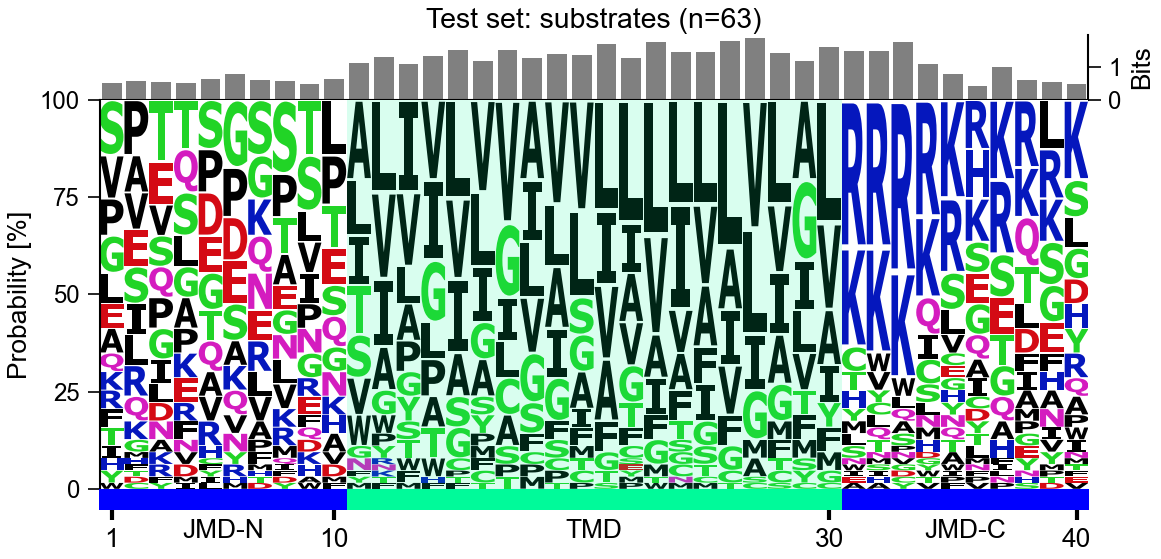
AAlogo — see the datadataset at a glance
import numpy as np, matplotlib.pyplot as plt, aaanalysis as aa
df_seq = aa.load_dataset(name='DOM_GSEC')   # γ-secretase
labels = list(df_seq['label']); df_scales = aa.load_scales()
sf = aa.SequenceFeature()
df_parts = sf.get_df_parts(df_seq=df_seq,
    list_parts=['tmd', 'jmd_n', 'jmd_c'])
aa.plot_settings(font_scale=0.7)
# aal_kws builds df_logo + bits bar for you
aa.AAlogoPlot().single_logo(
    aal_kws=dict(df_parts=df_parts, labels=labels,
        label_test=1, tmd_len=20),
    name_data='Test set: substrates')
plt.tight_layout(); plt.show()
AAlogoPlot.single_logo · per-position enrichment
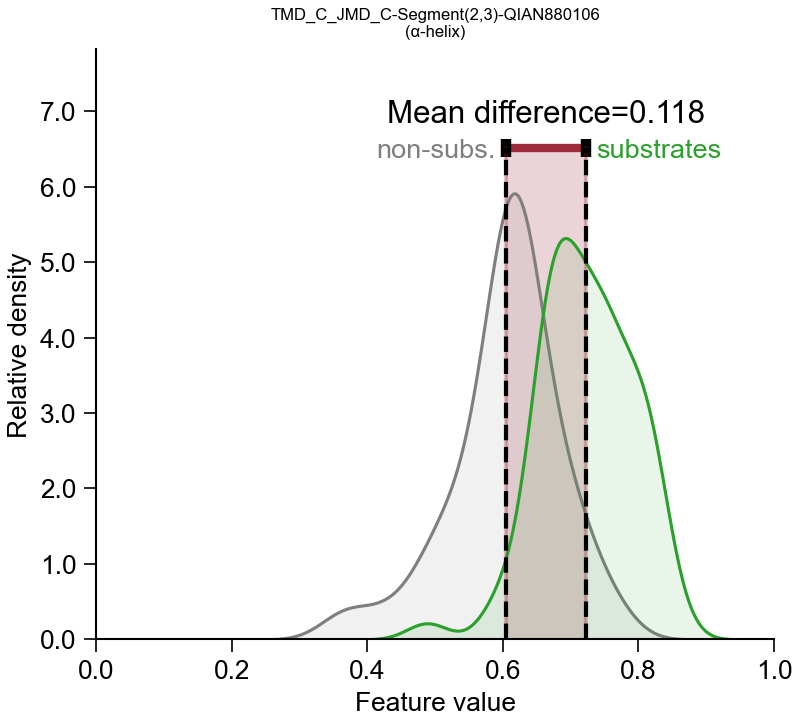
CPP — featuretop feature · test vs ref
# default parts + a redundancy-reduced set of 100 scales
df_parts = sf.get_df_parts(df_seq=df_seq)
df_scales = aa.AAclust().select_scales(
    df_scales=df_scales, n_clusters=100)
cpp = aa.CPP(df_parts=df_parts, df_scales=df_scales)
df_feat = cpp.run(labels=labels, n_filter=100)
X = sf.feature_matrix(df_feat['feature'], df_parts)
tm = aa.TreeModel(); tm.fit(X, labels=labels)
df_feat = tm.add_feat_importance(df_feat=df_feat, sort=True)
cpp_plot = aa.CPPPlot(); aa.plot_settings()
# distribution of the top feature (feat_rank=1 of the sorted df_feat)
cpp_plot.feature(feature=df_feat, feat_rank=1, df_seq=df_seq,
    labels=labels, name_test='substrates', name_ref='non-subs.')
plt.tight_layout(); plt.show()
▼ figure below · left
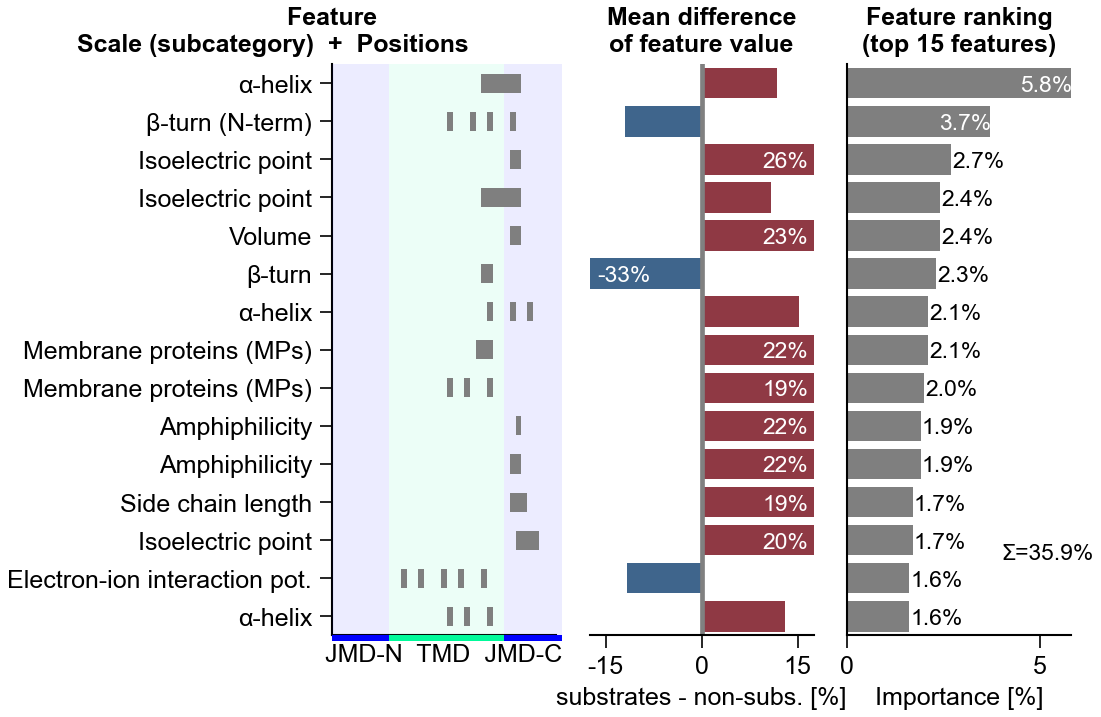
CPP — rankingtop features · effect + importance
# same df_feat — rank the top discriminative features
aa.plot_settings(font_scale=0.6)
cpp_plot.ranking(df_feat=df_feat, n_top=15, rank=True,
    name_test='substrates', name_ref='non-subs.')
plt.tight_layout(); plt.show()
▼ figure below · right
CPP — feature
CPPPlot.feature · top feature
CPP — ranking
CPPPlot.ranking · top-15 features
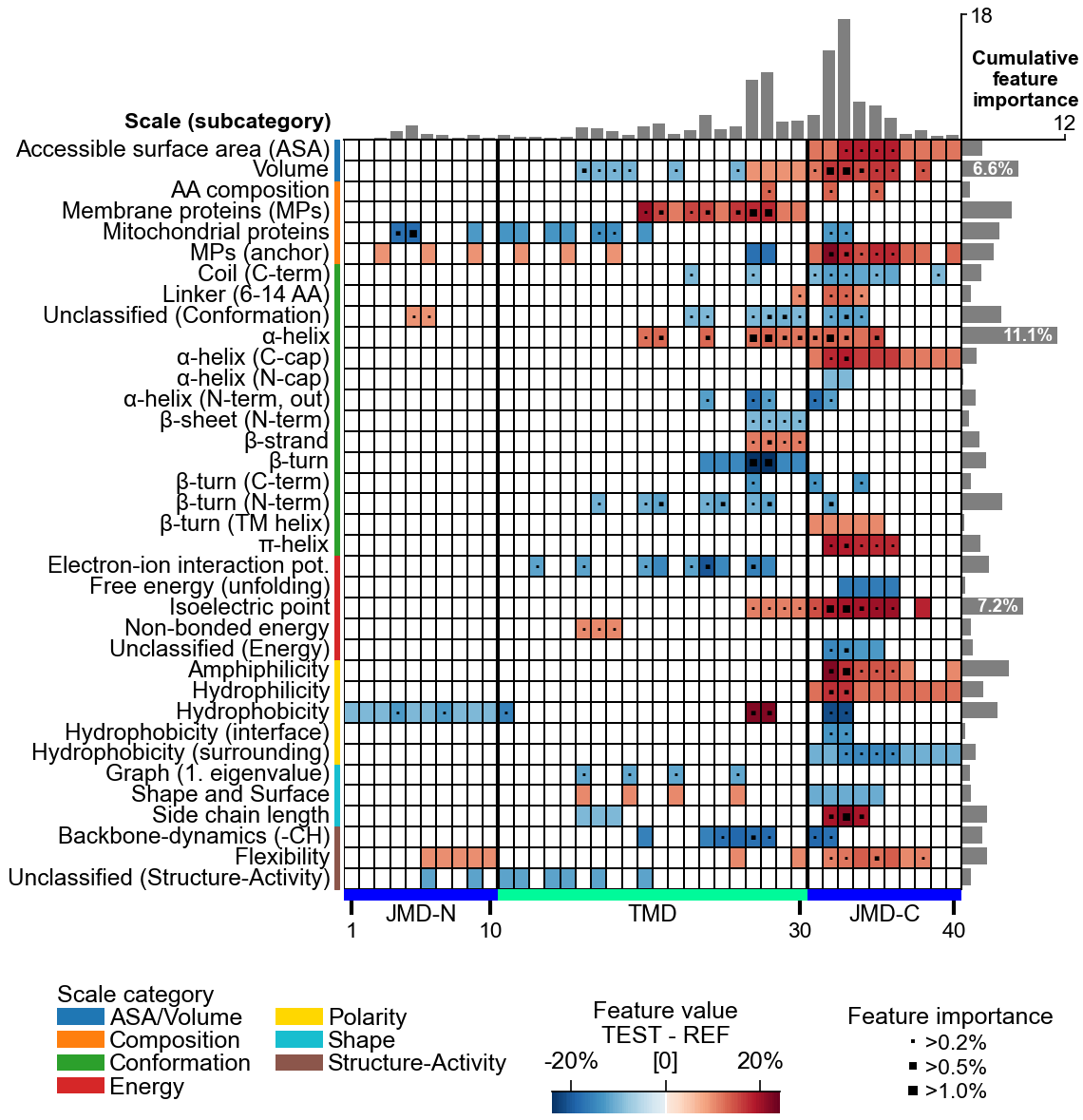
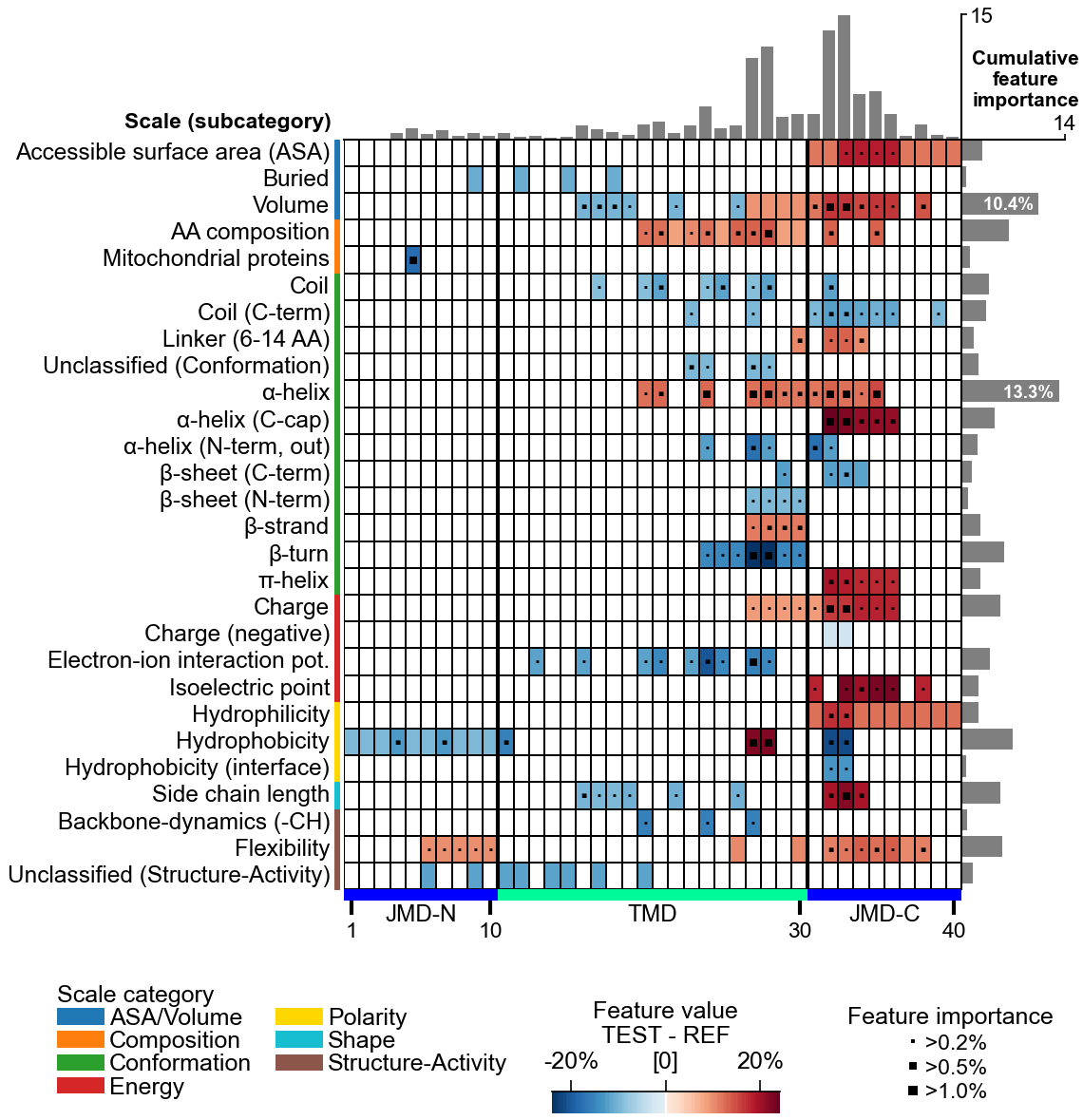
CPP — feature mapgroup level · importance
# global Part × Split × Scale map — all AAontology scales
cpp_plot = aa.CPPPlot(); aa.plot_settings(font_scale=0.65)
cpp_plot.feature_map(df_feat=df_feat)
# CPP.simplify → fewer, interpretable correlated scales
df_feat = cpp.simplify(df_feat=df_feat, labels=labels)
cpp_plot.feature_map(df_feat=df_feat)
plt.tight_layout(); plt.show()
CPP — feature map
CPPPlot.feature_map · all scales
CPP — feature map
CPPPlot.feature_map · simplified
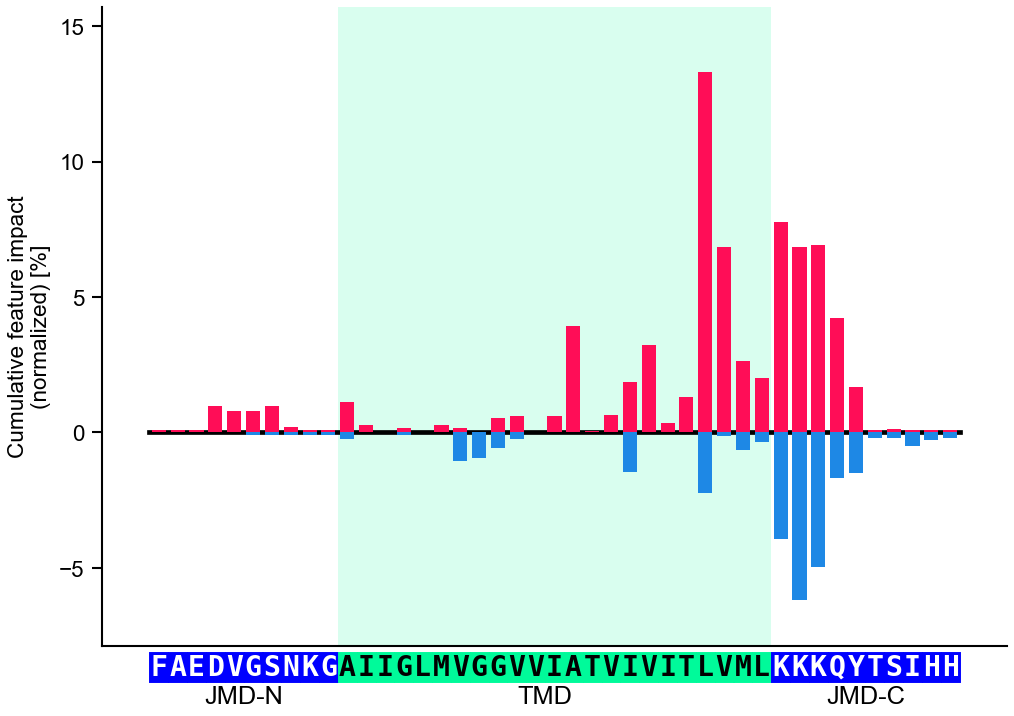
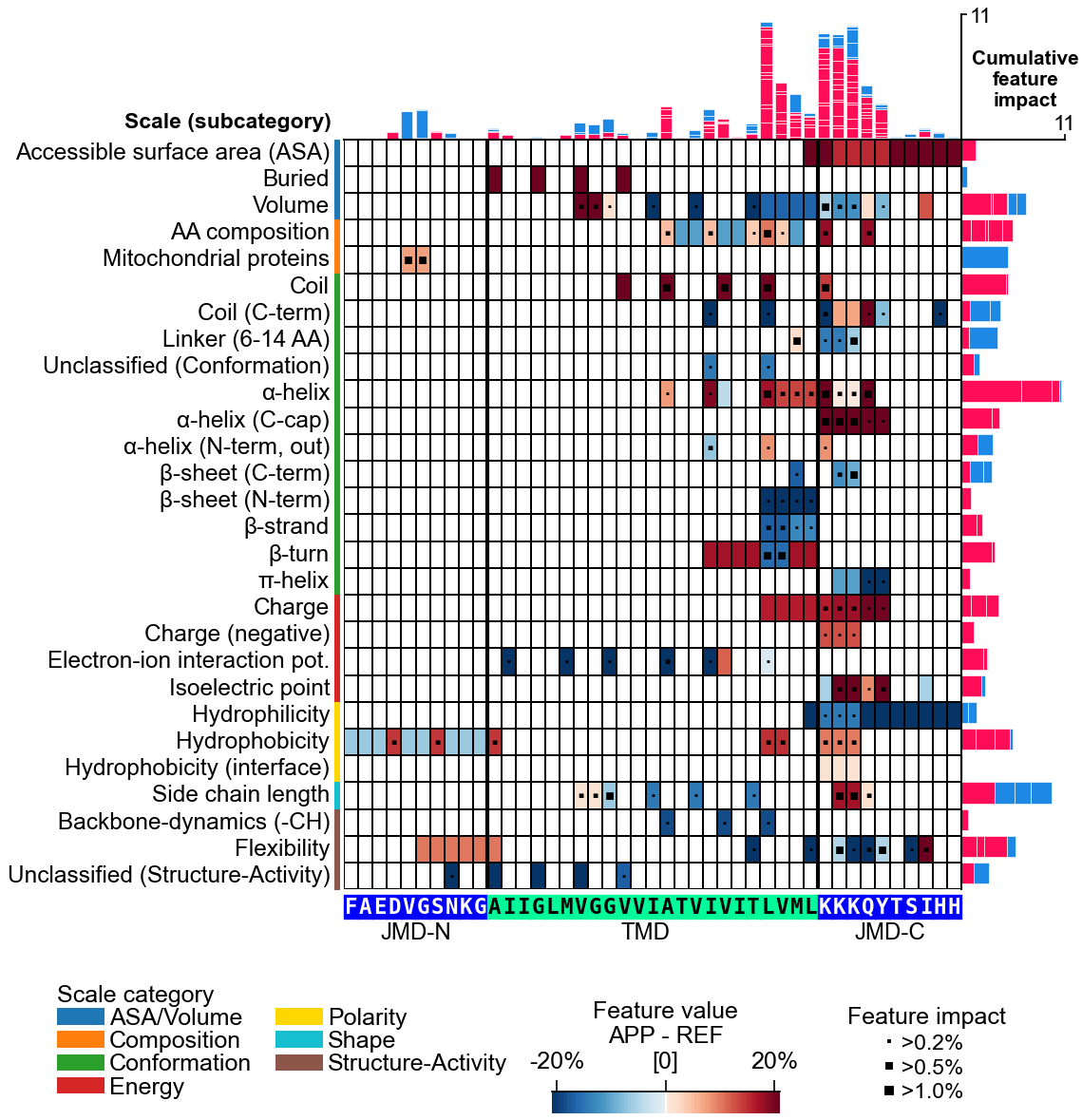
ShapModel — explain a predictionsample level · [pro]
# per-sample SHAP — APP's soft label (0.6), keyed by entry
sm = aa.ShapModel()
sm.fit(X, labels=labels, df_seq=df_seq,
       fuzzy_labels={'P05067': 0.6})
df_feat = sm.add_feat_impact(df_feat=df_feat, df_seq=df_seq,
                             samples='P05067', names='APP')
args_seq = sf.get_args_seq(df_seq=df_seq, sample='P05067')
ka = dict(col_imp='feat_impact_APP', shap_plot=True, **args_seq)
cpp_plot.profile(df_feat=df_feat, **ka)
# vmin/vmax=±21% → same colour scale as the global feature map (comparable)
cpp_plot.feature_map(df_feat=df_feat, name_test='APP',
                     vmin=-21, vmax=21, **ka)
plt.tight_layout(); plt.show()
ShapModel — explain a prediction
CPPPlot.profile · SHAP
ShapModel — explain a prediction
CPPPlot.feature_map · SHAP
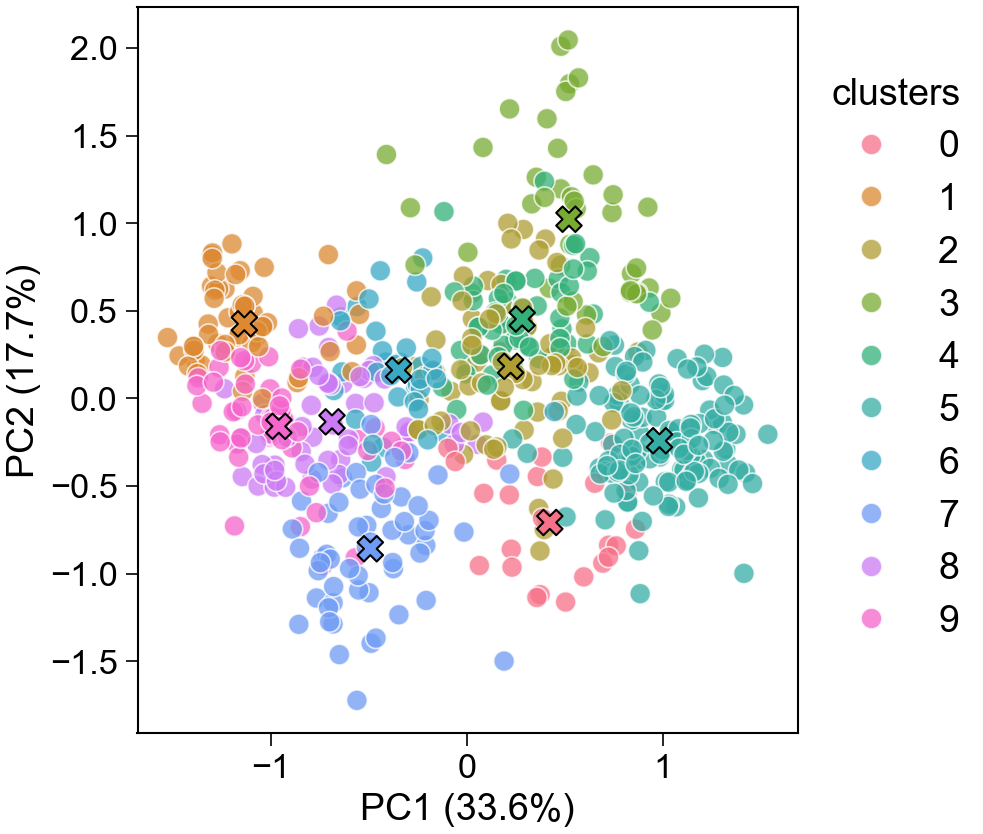
AAclust — clustersscale reduction · clustering
aac = aa.AAclust()
# pick a redundancy-reduced set of scales
aac.select_scales(df_scales, n_clusters=10)
aac.medoid_names_   # 10 reduced scales (labels_ also set)

aac_plot = aa.AAclustPlot()
aac_plot.centers(df_scales=df_scales, labels=aac.labels_)
plt.tight_layout(); plt.show()

# AAclust also reduces redundant proteins (not just scales)
df_seq = aac.select_proteins(df_seq=df_seq, X=X)
▼ figure below · left
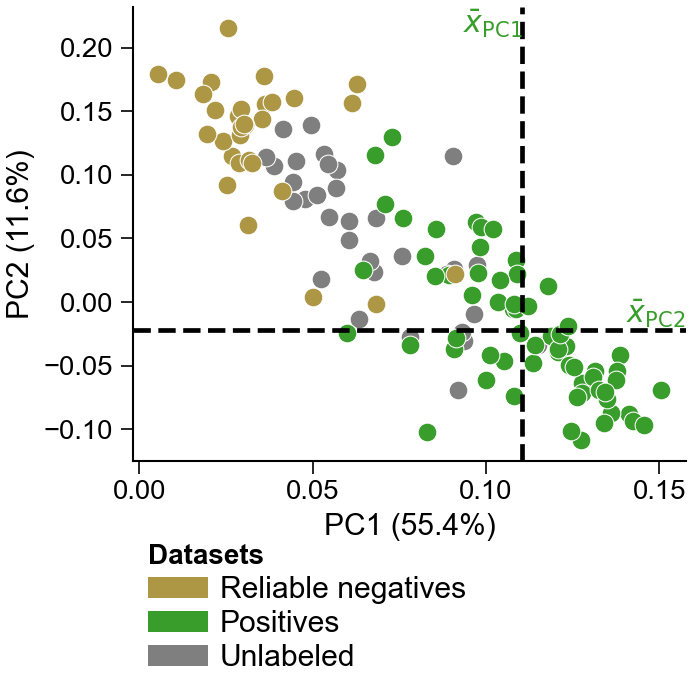
dPULearn — PCAreliable negatives · PU learning
# DOM_GSEC ships 1/0 — treat 0 as the unlabeled pool (label_unl=0)
dpul = aa.dPULearn()
dpul.fit(X=X, labels=labels, label_unl=0, n_neg=31)   # n_neg: reliable negatives to mine
df_pu = dpul.df_pu_   # out: 1 pos · 0 rel-neg · 2 unl

dpul_plot = aa.dPULearnPlot()
dpul_plot.pca(df_pu=df_pu, labels=dpul.labels_)
plt.tight_layout(); plt.show()
▼ figure below · right
AAclust — clusters
AAclustPlot.centers · cluster scale profiles
dPULearn — PCA
dPULearnPlot.pca · reliable negatives
AAWindowSamplerbuild reference windows
# Reference windows around sites when you lack negatives:
aaws = aa.AAWindowSampler()
# SAME proteins · window 9 (odd) -> PTM / single-residue site
df_same = aaws.sample_same_protein(df_seq, n=100, window_size=9)
# DIFFERENT proteins · window 10 (even) -> cleavage bond
df_diff = aaws.sample_different_protein(df_seq, n=100, window_size=10)
# SYNTHETIC — AA-frequency priors (null background)
df_syn = aaws.sample_synthetic(df_seq, n=100, generator='global_freq')
· Concepts & Reference
decision guide · gotchas · options · class ↔ plot · glossary · citations
Decision Guidepick your setup
What are you predicting?
per residue / site → AA_* · odd/even window · parts = window
per domain / region → DOM_* · TMD model · parts = jmd_n·tmd·jmd_c
whole protein → SEQ_* · composition · whole chain
What labels do you have?
labeled 0 / 1 CPP → ML model
positives + unlabeled (1 / 2) CPPdPULearn → ML model
no negatives at all AAWindowSamplerCPP → ML model
What is your learning task?
classify CPP → classifier (sklearn)
regress get_labels_quantile / tieredCPP → regression model
multi-class get_labels_ovr / ovoCPP → classifiers
cluster AAclust
Which explainability do you need?
group level CPPTreeModelCPPPlot → feature importance
per protein CPPShapModel proCPPPlot → feature impact
Gotchasthings that bite
  • Labels: 1/0 = supervised (pos/neg). dPULearn takes 1/0 (label_unl=0) or 1/2; n_neg = reliable negatives to mine; output 1 · 0 (rel-neg) · 2 (unl).
  • load_dataset(name, n=N) returns 2N rows (N per class) — count classes via df_seq['label'].
  • Compositional vs positional is not a flag — it emerges from split_kws.
  • Reproducibility: layered seeds — seed= ▸ random_state= ▸ options['random_state'] ▸ default.
  • DOM_* parts need tmd_start/tmd_stop in df_seq; [pro] features need pip install 'aaanalysis[pro]'.
Design Principlesthe AAanalysis way
  • Explicit over implicit — DataFrames everywhere
  • Wrappers (.fit / .predict / .eval) set trailing *_ attributes after fit
  • Biological interpretability is first-class
  • Small-data robust and reproducible (layered seeds)
Key Data Objectsshapes & columns
df_seqentry · sequence · label · tmd_start · tmd_stop
df_partsone column per part: tmd · jmd_n · jmd_c · …
df_featfeature · category · subcategory · scale_name · abs_auc · mean_dif · p_val · positions
Xfeature matrix (samples × features) from sf.feature_matrix
dict_num{entry: ndarray (L×D)} — numerical per-residue values
Class · abbr ↔ Plot Classmirrored API
classabbrplot classkind
SequencePreprocessorsp
EmbeddingPreprocessorep
StructurePreprocessor prostp
AnnotationPreprocessor proap
AAlogoaalAAlogoPlot
AAWindowSampleraaws
SequenceFeaturesf
NumericalFeaturenf
AAclustaacAAclustPlotWrapper
CPPcppCPPPlot
dPULearndpuldPULearnPlotWrapper
TreeModeltmWrapper
ShapModel prosmWrapper
AAMutaamutAAMutPlot
SeqMutseqmutSeqMutPlot
aa.optionssystem-level settings
aa.options['random_state'] = 42
aa.options['verbose'] = True
aa.options['n_jobs'] = -1            # all cores (None = auto)
aa.options['allow_multiprocessing'] = True

# TMD model — JMD flank widths
aa.options['jmd_n_len'] = 10
aa.options['jmd_c_len'] = 10

# plot labels & system-level scales
aa.options['name_tmd'] = 'P5-P5′'   # e.g. cleavage site
aa.options['df_scales'] = my_scales
How to Citeif you use AAanalysis
[Breimann24a]AAclust
Breimann & Frishman (2024a), AAclust: k-optimized clustering for selecting redundancy-reduced sets of amino acid scales
[Breimann24b]AAontology
Breimann et al. (2024b), AAontology: An ontology of amino acid scales for interpretable machine learning
[Breimann25]CPP & dPULearn
Breimann & Kamp et al. (2025), Charting γ-secretase substrates by explainable AI
Glossarycanonical vocabulary · CONTEXT.md
Feature (CPP) — (Part × Split × Scale) — the atomic, residue-grounded, interpretable unit of CPP.
Part — Named segment used as feature input: tmd, jmd_n, jmd_c, tmd_jmd, jmd_n_tmd_n, tmd_c_jmd_c.
TMD (Target Middle Domain) — The central variable-length sequence segment of interest, made comparable across samples by splitting. Called “transmembrane domain” in Breimann25, but generalized here to any target segment.
JMD (Juxta Middle Domain) — The fixed-length flanking regions adjacent to the TMD: jmd_n (N-terminal side) and jmd_c (C-terminal side); called “juxtamembrane domain” in Breimann25.
Split — How a scale is read across a part: Segment (contiguous), Pattern (sparse), PeriodicPattern (i, i+3/4).
Scale — AA (amino acid) → ℝ mapping. AAontology ships ~600 curated scales in two-level categories.
AAontology — Two-level scale taxonomy; CPP uses its categories to organize and rank features.
CPP — Comparative Physicochemical Profiling — discovers ranked Part × Split × Scale features.
Test vs reference group — The A-vs-B contrast CPP profiles: a feature's mean_dif is test − reference (name_test / name_ref in CPPPlot).
Compositional vs positional — How split_kws resolves locality: a whole-part average (compositional) vs sub-region/position-resolved (positional).
Numerical CPP (pseudo-scale) v1.1 — CPP generalizes from AA→scale lookup to any per-residue tensor — PLM (protein language model) · structure (PDB file) · functional annotations (e.g. PTMs) — each a pseudo-scale via CPP.run_num.
Feature importance vs impact — Two explainability axes: importance = unsigned, group-level (TreeModel); impact = signed, per-sample (ShapModel, shap_plot).
Reducing features — Four distinct ops: redundancy reduction (AAclust scales) · feature pruning · selection (RFE, recursive feature elimination) · simplification (CPP.simplify → interpretable scales).
PU learning (Positive-Unlabeled learning) — Training from labeled positives and unlabeled data only (no curated negatives); dPULearn infers reliable negatives from the unlabeled pool.
PU labels — dPULearn input: 1 = positive, 2 = unlabeled. Output: 1 / 0 (reliable-negative) / 2.
Wrapper class — sklearn-style class — .fit / .predict / .eval, sets trailing *_ attributes after fit.
Plot class — *Plot mirror of an analytical class — same arguments, visualization only.