Quick start with AAanalysis
This is a short introduction to AAanalysis, a Python framework for sequence-based protein prediction, centered around the Comparative Physical Profiling (CPP) algorithm for interpretable feature engineering.
First, import some third-party packages and aanalysis:
import seaborn as sns
import matplotlib.pyplot as plt
import pandas as pd
import numpy as np

import aaanalysis as aa
aa.options["verbose"] = False
aa.options["random_state"] = 42
Data Loading
We can load a dataset of amino acid scales using the
aa.load_scales() function. Dataset of protein sequences for a binary
classification task, such as our γ-secretase substrates (n=63) and
non-substrates (n=63) dataset ([Breimann25a]), can be retrieved via the
aa.load_dataest() function:
# Load example dataset and scales
df_seq = aa.load_dataset(name="DOM_GSEC")
labels = list(df_seq["label"])
df_scales = aa.load_scales()
Feature Engineering
To start feature engineering, we can utilize the AAclust model for
selecting a redundancy-reduced set of amino acid scales:
# Obtain redundancy-reduced set of 100 scales
aac = aa.AAclust()
X = np.array(df_scales).T
scales = aac.fit(X, names=list(df_scales), n_clusters=100).medoid_names_
df_scales = df_scales[scales]
We can now use the CPP algorithm, which aims at identifying a set of
features that are most discriminant between two sets of sequences. It´s
core idea is the CPP feature concept, defined as a combination of
Parts, Splits, and Scales. Parts and Splits can be
obtained using SequenceFeature.
We first create a set of baseline features:
sf = aa.SequenceFeature()

# Obtain Parts and Splits
df_parts = sf.get_df_parts(df_seq=df_seq, list_parts=["tmd"])
split_kws = sf.get_split_kws(n_split_max=1, split_types=["Segment"])
Running CPP via CPP.run() creates all Part-Split-Scale
combinations and filters them down to a user-defined maximum of
non-redundant features (100 by default). As baseline, we use CPP without
filtering (max_cor=1) to compute the average values for the 100
selected scales over the entire TMD sequences:
# Create 100 baseline features (Scale values averaged over TMD)
cpp = aa.CPP(df_scales=df_scales, df_parts=df_parts, split_kws=split_kws)
df_feat_baseline = cpp.run(labels=labels, max_cor=1)
aa.display_df(df=df_feat_baseline, n_rows=8)
| feature | category | subcategory | scale_name | scale_description | abs_auc | abs_mean_dif | mean_dif | std_test | std_ref | p_val_mann_whitney | p_val_fdr_bh | positions | |
|---|---|---|---|---|---|---|---|---|---|---|---|---|---|
| 1 | TMD-Segment(1,1)-WOLR790101 | Polarity | Hydrophobicity (surrounding) | Hydration potential | Hydrophobicity ...n et al., 1979) | 0.257000 | 0.037000 | 0.037000 | 0.028000 | 0.042000 | 0.000001 | 0.000064 | 11,12,13,14,15,...,26,27,28,29,30 |
| 2 | TMD-Segment(1,1)-FUKS010106 | Composition | Membrane proteins (MPs) | Proteins of mesophiles (INT) | Interior compos...ishikawa, 2001) | 0.240000 | 0.068000 | 0.068000 | 0.065000 | 0.082000 | 0.000003 | 0.000160 | 11,12,13,14,15,...,26,27,28,29,30 |
| 3 | TMD-Segment(1,1)-BEGF750103 | Conformation | β-turn | β-turn | Conformational ...in-Dirkx, 1975) | 0.237000 | 0.064000 | -0.064000 | 0.067000 | 0.087000 | 0.000004 | 0.000147 | 11,12,13,14,15,...,26,27,28,29,30 |
| 4 | TMD-Segment(1,1)-FASG760105 | Polarity | Unclassified (Polarity) | pK-C | pK-C (Fasman, 1976) | 0.234000 | 0.044000 | 0.044000 | 0.038000 | 0.057000 | 0.000006 | 0.000142 | 11,12,13,14,15,...,26,27,28,29,30 |
| 5 | TMD-Segment(1,1)-YUTK870104 | Energy | Free energy (unfolding) | Free energy (unfolding) | Activation Gibb...i et al., 1987) | 0.234000 | 0.011000 | 0.011000 | 0.010000 | 0.020000 | 0.000006 | 0.000121 | 11,12,13,14,15,...,26,27,28,29,30 |
| 6 | TMD-Segment(1,1)-LINS030116 | ASA/Volume | Accessible surface area (ASA) | ASA (folded β-strand) | Total median ac...s et al., 2003) | 0.230000 | 0.028000 | -0.028000 | 0.021000 | 0.039000 | 0.000008 | 0.000137 | 11,12,13,14,15,...,26,27,28,29,30 |
| 7 | TMD-Segment(1,1)-ANDN920101 | Structure-Activity | Backbone-dynamics (-CH) | α-CH chemical s...kbone-dynamics) | alpha-CH chemic...n et al., 1992) | 0.229000 | 0.068000 | -0.068000 | 0.073000 | 0.081000 | 0.000009 | 0.000102 | 11,12,13,14,15,...,26,27,28,29,30 |
| 8 | TMD-Segment(1,1)-ROBB760109 | Conformation | β-turn (N-term) | β-turn (1st residue) | Information mea...n-Suzuki, 1976) | 0.229000 | 0.039000 | -0.039000 | 0.041000 | 0.047000 | 0.000009 | 0.000115 | 11,12,13,14,15,...,26,27,28,29,30 |
By default, CPP creates around 100,000 Part-Slit combinations:
# CPP creates around 100,000 features and filters them down to 100
df_parts = sf.get_df_parts(df_seq=df_seq)
cpp = aa.CPP(df_scales=df_scales, df_parts=df_parts)
df_feat = cpp.run(labels=labels)
aa.display_df(df=df_feat, n_rows=8)
| feature | category | subcategory | scale_name | scale_description | abs_auc | abs_mean_dif | mean_dif | std_test | std_ref | p_val_mann_whitney | p_val_fdr_bh | positions | |
|---|---|---|---|---|---|---|---|---|---|---|---|---|---|
| 1 | TMD_C_JMD_C-Seg...2,3)-QIAN880106 | Conformation | α-helix | α-helix (middle) | Weights for alp...ejnowski, 1988) | 0.387000 | 0.118000 | 0.118000 | 0.068000 | 0.080000 | 0.000000 | 0.000000 | 27,28,29,30,31,32,33 |
| 2 | TMD_C_JMD_C-Pat...,12)-ROBB760109 | Conformation | β-turn (N-term) | β-turn (1st residue) | Information mea...n-Suzuki, 1976) | 0.363000 | 0.119000 | -0.119000 | 0.065000 | 0.085000 | 0.000000 | 0.000000 | 21,25,28,32 |
| 3 | TMD_C_JMD_C-Seg...6,9)-ZIMJ680104 | Energy | Isoelectric point | Isoelectric point | Isoelectric poi...n et al., 1968) | 0.352000 | 0.268000 | 0.268000 | 0.174000 | 0.173000 | 0.000000 | 0.000000 | 32,33 |
| 4 | TMD_C_JMD_C-Seg...4,9)-ROBB760113 | Conformation | β-turn | β-turn | Information mea...n-Suzuki, 1976) | 0.349000 | 0.337000 | -0.337000 | 0.177000 | 0.254000 | 0.000000 | 0.000000 | 27,28 |
| 5 | TMD_C_JMD_C-Seg...4,5)-ZIMJ680104 | Energy | Isoelectric point | Isoelectric point | Isoelectric poi...n et al., 1968) | 0.336000 | 0.205000 | 0.205000 | 0.134000 | 0.157000 | 0.000000 | 0.000000 | 33,34,35,36 |
| 6 | TMD_C_JMD_C-Pat...,15)-QIAN880106 | Conformation | α-helix | α-helix (middle) | Weights for alp...ejnowski, 1988) | 0.336000 | 0.152000 | 0.152000 | 0.102000 | 0.132000 | 0.000000 | 0.000000 | 28,32,35 |
| 7 | TMD_C_JMD_C-Seg...6,9)-LINS030101 | ASA/Volume | Volume | Accessible surface area (ASA) | Total accessibl...s et al., 2003) | 0.328000 | 0.235000 | 0.235000 | 0.156000 | 0.187000 | 0.000000 | 0.000000 | 32,33 |
| 8 | TMD_C_JMD_C-Seg...2,3)-ZIMJ680104 | Energy | Isoelectric point | Isoelectric point | Isoelectric poi...n et al., 1968) | 0.326000 | 0.108000 | 0.108000 | 0.077000 | 0.085000 | 0.000000 | 0.000000 | 27,28,29,30,31,32,33 |
Machine Learning (Protein Prediction)
A feature matrix for a given set of CPP features can be created using
the SequenceFeature.feature_matrix() method. The feature matrix will
be used to train a Random Forest
Classifier
model:
from sklearn.ensemble import RandomForestClassifier
from sklearn.model_selection import cross_val_score

# Create feature matrix and perform prediction for baseline features
X = sf.feature_matrix(df_parts=df_parts, features=df_feat_baseline["feature"])
rf = RandomForestClassifier()
cv_base = cross_val_score(rf, X, labels, scoring="accuracy", cv=5)
print(f"Mean accuracy of {round(np.mean(cv_base), 2)}")
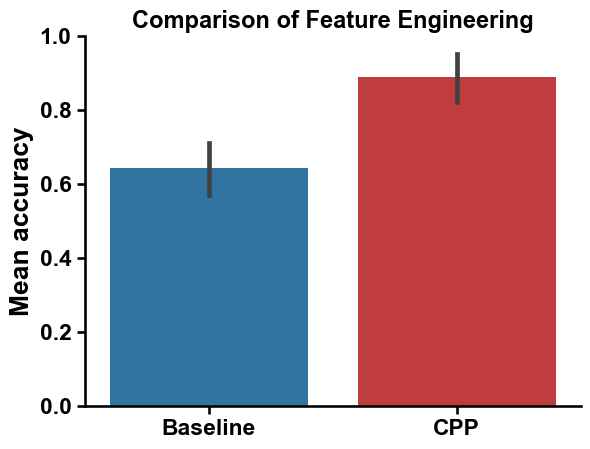
Mean accuracy of 0.64
We create now the feature matrix for the features obtained with CPP default settings:
# Create feature matrix and perform prediction for default CPP features
X = sf.feature_matrix(df_parts=df_parts, features=df_feat["feature"])
rf = RandomForestClassifier()
cv = cross_val_score(rf, X, labels, scoring="accuracy", cv=5)
print(f"Mean accuracy of {round(np.mean(cv), 2)}")
Mean accuracy of 0.89
We can compare the baseline and default CPP feature set using a bar chart:
# Comparison of baseline and default CPP feature sets
aa.plot_settings()
sns.barplot(pd.DataFrame({"Baseline": cv_base, "CPP": cv}), palette=["tab:blue", "tab:red"])
plt.ylabel("Mean accuracy", size=aa.plot_gcfs()+1)
plt.ylim(0, 1)
plt.title("Comparison of Feature Engineering", size=aa.plot_gcfs()-1)
sns.despine()
plt.show()
CPP Analysis (group level)
AAanalysis offers various plotting functions for interpreting the CPP
features at group and sample level by CPPPlot. We first need to
include the group-level feature importance using the TreeModel and
its TreeModel.add_feat_importance() method:
# Include group level feature importance
tm = aa.TreeModel()
tm.fit(X, labels=labels)
df_feat = tm.add_feat_importance(df_feat=df_feat)
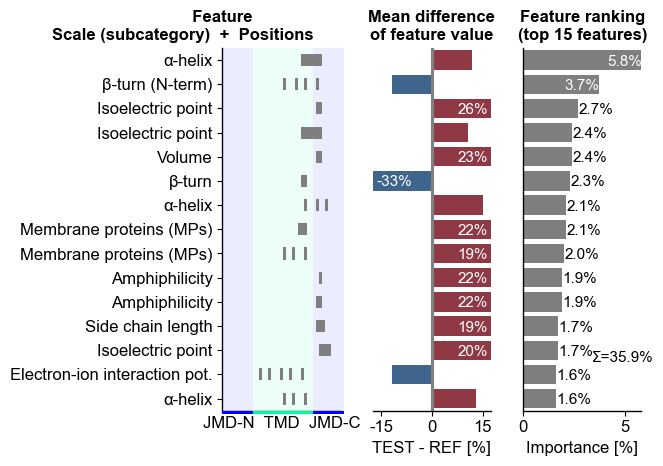
The top15 features can be displayed using the CPPPlot.ranking()
method:
# Plot CPP ranking
cpp_plot = aa.CPPPlot()
aa.plot_settings(short_ticks=True, weight_bold=False)
cpp_plot.ranking(df_feat=df_feat)
plt.tight_layout()
plt.show()
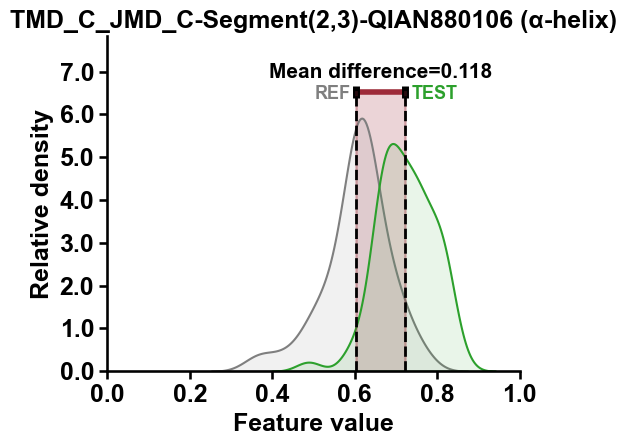
The distributions of features values for the highest-ranked feature can
be displayed using the CPPPlot.feature() method:
top_feature = df_feat["feature"][0]
top_subcategory = df_feat["subcategory"][0]
aa.plot_settings()
cpp_plot.feature(feature=top_feature , df_seq=df_seq, labels=labels)
plt.title(f"{top_feature} ({top_subcategory})")
plt.tight_layout()
plt.show()
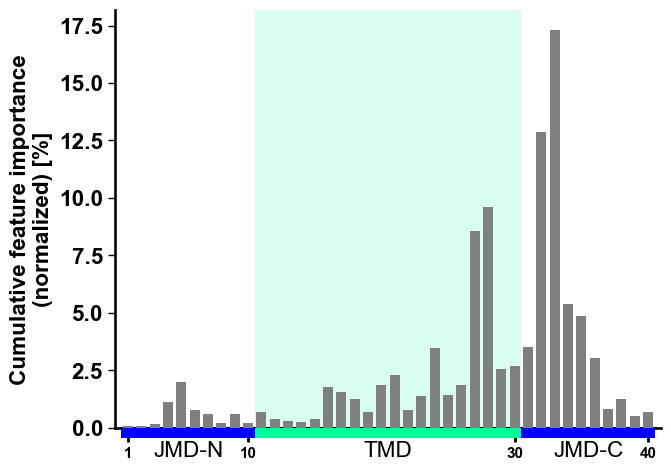
The cumulative feature importance per residue position can be visualized
by the CPPPlot.profile() method:
# Plot CPP profile
aa.plot_settings(font_scale=0.9)
cpp_plot.profile(df_feat=df_feat)
plt.tight_layout()
plt.show()
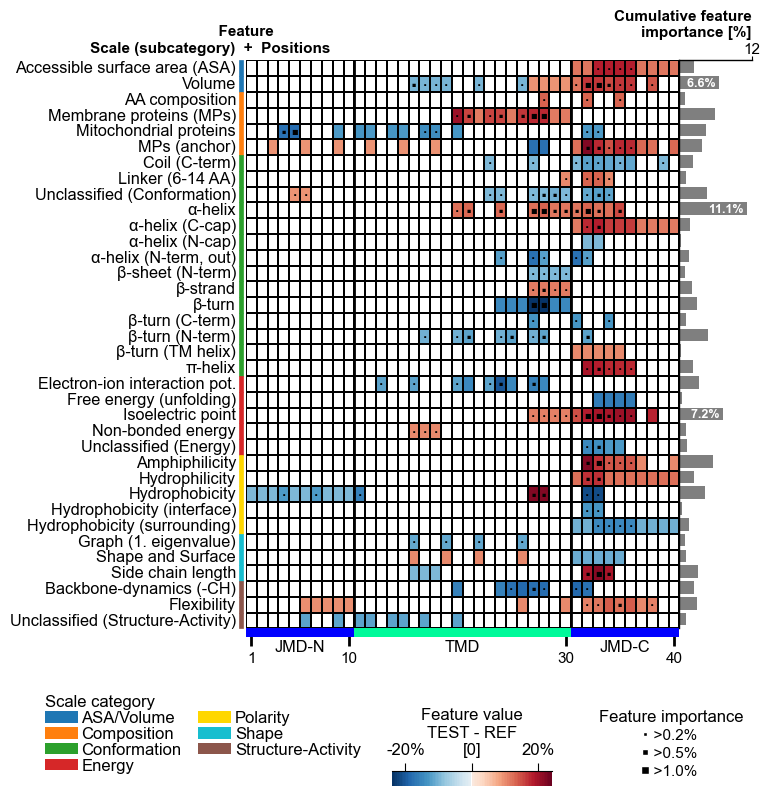
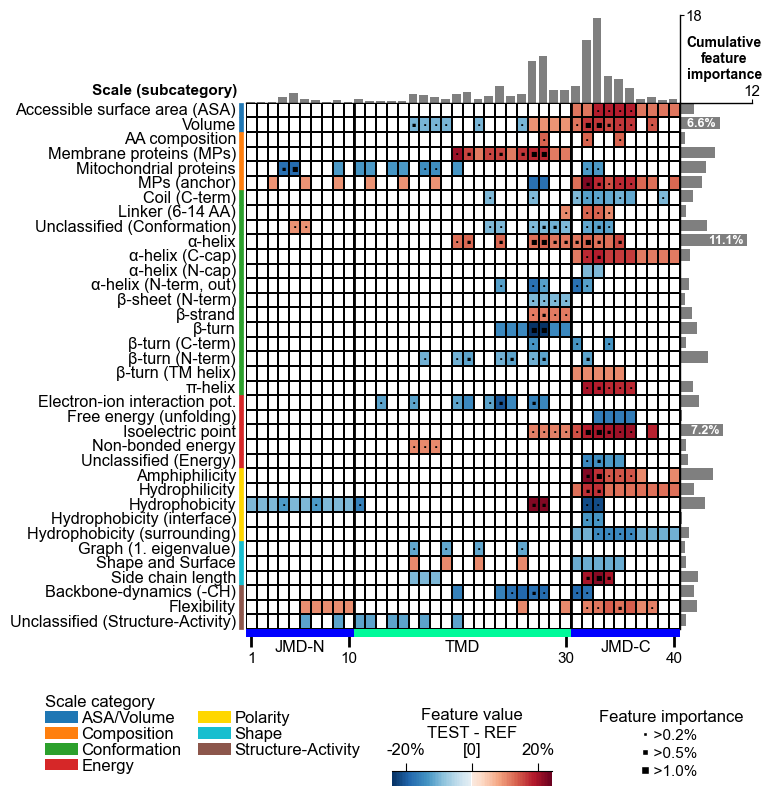
To uncover the common physicochemical signature discriminating the test
from the reference protein set, use the CPPPlot.feature_map() method
showing the feature value differences per scale subcategory at
single-residue resolution:
# Plot CPP feature map (original version: without importance bars on top)
cpp_plot = aa.CPPPlot()
aa.plot_settings(font_scale=0.65, weight_bold=False)
cpp_plot.feature_map(df_feat=df_feat, add_imp_bar_top=False)
plt.show()
# Plot CPP feature map (v1.0.2+: with importance bars on top)
cpp_plot = aa.CPPPlot()
aa.plot_settings(font_scale=0.65, weight_bold=False)
cpp_plot.feature_map(df_feat=df_feat)
plt.show()
CPP-SHAP Analysis (sample level)
We can analyse the impact of features on the prediction score for
individual sequence using the ShapExplainer model, which combines
CPP with the explainable AI framework
SHAP.
# Obtain sample-specific feature impact
sm = aa.ShapModel()
sm.fit(X, labels=labels)
df_feat = sm.add_feat_impact(df_feat=df_feat)
df_feat = sm.add_sample_mean_dif(X, labels=labels, df_feat=df_feat)
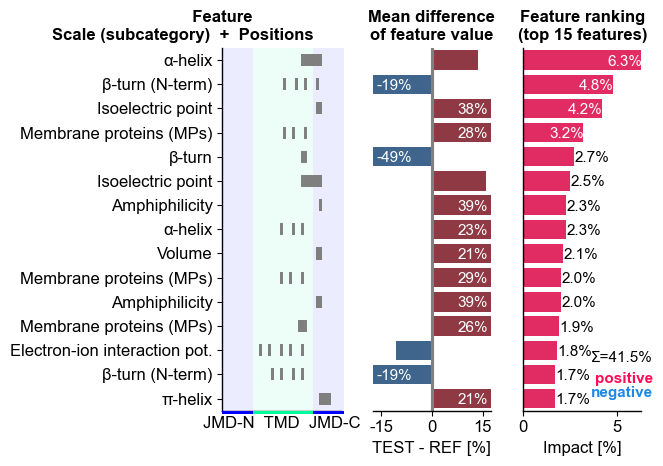
We can now show the feature ranking for a selected protein (‘Protein0’)
using the CPPPlot.ranking() method, plotting SHAP analysis results
by setting shap_plot=True:
# CPP-SHAP ranking plot
aa.plot_settings(short_ticks=True, weight_bold=False)
cpp_plot.ranking(df_feat=df_feat, shap_plot=True, col_dif="mean_dif_Protein0", col_imp="feat_impact_Protein0")
plt.tight_layout()
plt.show()
To visualize the CPP-SHAP profile and heatmap, we need to obtain the sequence parts of the respective protein:
# Get sequences parts for APP
_df_parts = sf.get_df_parts(df_seq=df_seq, list_parts=["tmd", "jmd_c", "jmd_n"])
_args_seq = _df_parts.loc["P05067"].to_dict()
args_seq = {key + "_seq": _args_seq[key] for key in _args_seq}
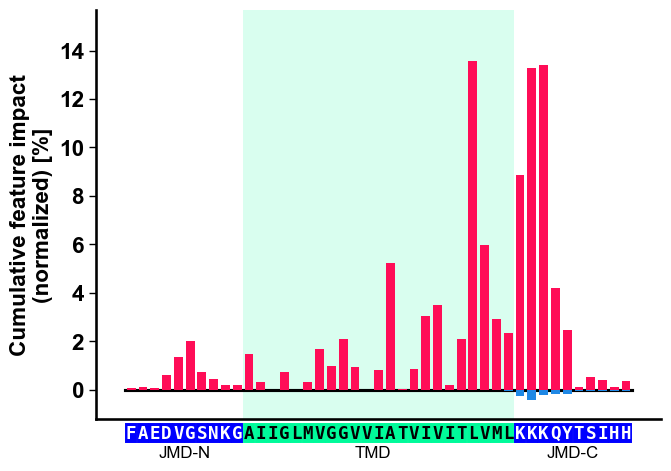
Show the specific CPP-SHAP Profile for the first Protein using the
CPPPlot.profile() method with setting shap_plot=True:
# CPP-SHAP profile
aa.plot_settings(font_scale=0.9)
cpp_plot.profile(df_feat=df_feat, shap_plot=True, col_imp="feat_impact_Protein0", **args_seq)
plt.tight_layout()
plt.show()
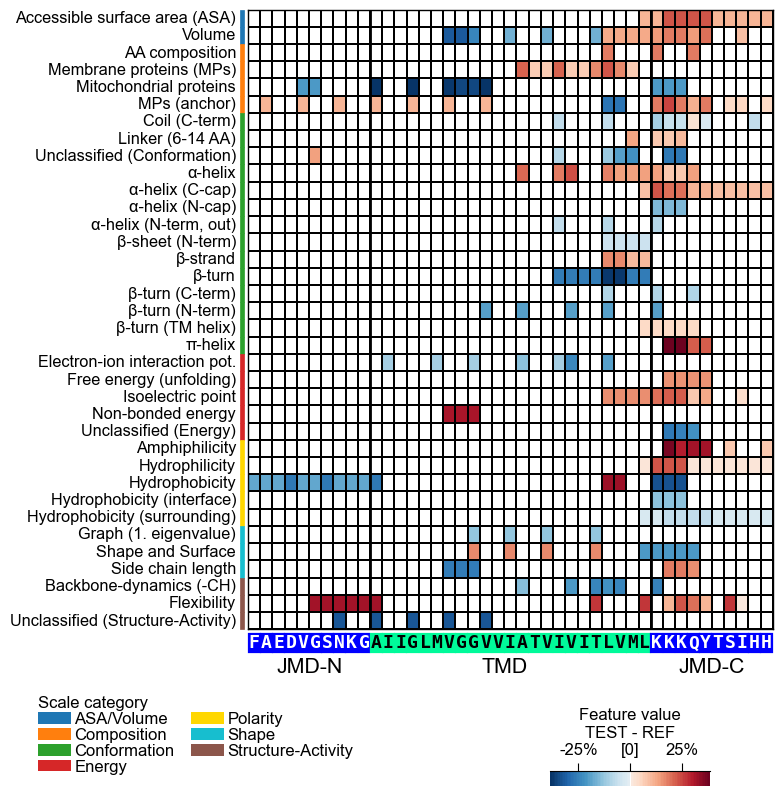
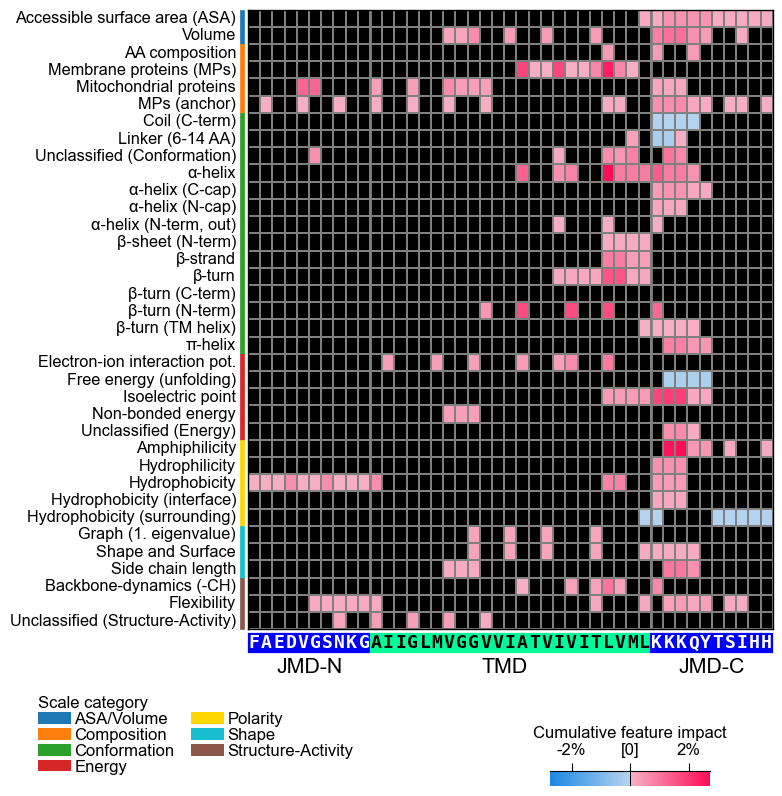
With the CPPPlot.heatmap() we can visualize the sample-specific
feature value difference and the feature impact per scale subcategory
and residue position:
# CPP heatmap (sample level)
aa.plot_settings(font_scale=0.65, weight_bold=False)
cpp_plot.heatmap(df_feat=df_feat, shap_plot=True, col_val="mean_dif_Protein0", **args_seq)
plt.show()

# CPP-SHAP heatmap (sample level)
cpp_plot.heatmap(df_feat=df_feat, shap_plot=True, col_val="feat_impact_Protein0", **args_seq)
plt.show()
See our Feature Engineering
API
for a comprehensive documentation on the CPP, CPPPlot,
AAclust, and SequenceFeature classes.