obtain_samples
- obtain_samples(df_seq, pos_col='pos', strategy='same_protein', n=None, window_size=9, reliable_negatives=False, df_feat=None, max_similarity_to_test=None, plot=False, seed=None, n_jobs=None, verbose=False)[source]
Obtain a balanced training set from a described sampling situation in one call.
The first golden pipeline of a typical workflow: instead of hand-driving
AAWindowSampler(roles, strategies, per-call seeds) and, for positive-unlabeled problems,dPULearn, the parameters here simply describe the situation. The known positives are the rows ofdf_seqcarrying 1-based anchors inpos_col;nreference windows are drawn to balance them according tostrategyand concatenated into one labeled'segments'-mode set, alongside a small balance / leakage / coverage report. A thin, stateless facade: it adds no sampling algorithm and its defaults are byte-identical to the equivalent explicit primitive calls.- Parameters:
df_seq (pd.DataFrame, shape (n_samples, n_seq_info)) – DataFrame with an
entrycolumn of unique protein identifiers, asequencecolumn of full protein sequences, and apos_colcolumn of 1-based positive positions.pos_col (str, default='pos') – Column with per-row 1-based positive (test) positions; list-like, scalar, or a comma/semicolon-separated string per row. Rows with empty / missing cells carry no positive.
strategy (str, default='same_protein') –
The sampling situation, mapped to one
AAWindowSamplercall:'same_protein'— within-protein hard negatives (sample_same_protein()).'different_protein'— cross-protein unlabeled windows (sample_different_protein()); the natural unlabeled poolUand the required situation forreliable_negatives.'synthetic'— synthetic control windows (sample_synthetic()).
n (int, optional) – Number of reference/negative windows to draw. If
None(default), it matches the number of positive windows, yielding a balanced set.window_size (int, default=9) – Length of each sampled window in residues.
reliable_negatives (bool, default=False) – If
True, engage the positive-unlabeled (PU) path: sample an unlabeled cross-protein pool and refine it into reliable negatives withdPULearn. Requiresdf_featandstrategy='different_protein'.df_feat (pd.DataFrame, optional) – Feature DataFrame with a
featurecolumn. Required whenreliable_negativesisTrue(used to build the feature matrixXfor dPULearn); ignored otherwise. The features must be compatible with windows anchored as a length-window_sizeTMD with the default JMD flanks.max_similarity_to_test (float in [0, 1], optional) – If set, drop sampled windows whose per-position identity to any test window exceeds this threshold (anti-leakage); passed through to
AAWindowSampler.plot (bool, default=False) – If
True, draw a stacked sequence-logo comparison of the sampled groups — one probability logo perrole(e.g.Testvs the references) with a bits info-content bar on top, labeled"<role> (n=…)"and using P-site x-axis notation — so their composition / conservation can be compared, and return its list ofAxespairs.seed (int, optional) – The seed used by the random number generator. If a positive integer, results of stochastic processes are reproducible.
n_jobs (int, optional) – Number of CPU cores (>=1) for building the feature matrix on the PU path. If
None, the optimized number is used.verbose (bool, default=False) – If
True, verbose progress information is printed.
- Returns:
df_samples (pd.DataFrame) – The balanced training set in
'segments'mode: positive test windows (label=1,role='Test') plus the sampled references (label=0), with full row provenance in therole/strategycolumns.ax (list of (matplotlib.axes.Axes, matplotlib.axes.Axes) or None) – Per-group
(logo, info-bar)axes pairs of the sequence-logo comparison, one perrolegroup, orNonewhenplot=False.df_eval (pd.DataFrame) – One-row balance / leakage / coverage report (positive / negative counts, balance ratio, number of source proteins, protein coverage, and maximum identity of any sampled window to a test window).
See also
AAWindowSamplerfor the window-sampling primitives this pipeline wraps.dPULearnfor the reliable-negative identification used by the PU path.AALogoPlotfor the sequence-logo comparison drawn whenplot=True.
Examples
The
aaanalysis.pipe(ap) module provides high-level golden pipelines — stateless, one-call wrappers over the AAanalysis primitives.ap.obtain_samplesis the first pipeline of a typical workflow: instead of hand-driving :class:AAWindowSampler(and, for positive-unlabeled problems, :class:dPULearn), the parameters simply describe the sampling situation. The known positives are the rows ofdf_seqcarrying 1-based anchors inpos_col; reference windows are drawn to balance them and returned as one labeled'segments'-mode training set, alongside a quick balance / leakage / coverage report.We load the
DOM_GSECexample dataset (see [Breimann25]) and mark a positive anchor at the center of every membrane-protein (label == 1); the remaining proteins carry no positive and form the cross-protein unlabeled pool:import matplotlib.pyplot as plt import numpy as np import aaanalysis as aa import aaanalysis.pipe as ap aa.options["verbose"] = False df_seq = aa.load_dataset(name="DOM_GSEC", n=20)[["entry", "sequence", "label"]].copy() df_seq["pos"] = (df_seq["sequence"].str.len() // 2).astype(int) df_seq.loc[df_seq["label"] == 0, "pos"] = np.nan # proteins without a positive = unlabeled pool aa.display_df(df_seq, n_rows=10, show_shape=True)
DataFrame shape: (40, 4)
entry sequence label pos 1 Q14802 MQKVTLGLLVFLAGF...PGETPPLITPGSAQS 0 nan 2 Q86UE4 MAARSWQDELAQQAE...SPKQIKKKKKARRET 0 nan 3 Q969W9 MHRLMGVNSTAAAAA...AIWSKEKDKQKGHPL 0 nan 4 P53801 MAPGVARGPTPYWRL...GLFKEENPYARFENN 0 nan 5 Q8IUW5 MAPRALPGSAVLAAA...EVPATPVKRERSGTE 0 nan 6 P01135 MVPSAGQLALFALGI...LLKGRTACCHSETVV 0 nan 7 O43914 MGGLEPCSRLLLLPL...SDVYSDLNTQRPYYK 0 nan 8 P05556 MNLQPIFWIGLISSV...KSAVTTVVNPKYEGK 0 nan 9 P16234 MGTSHPAFLVLGCLL...DIGIDSSDLVEDSFL 0 nan 10 P50895 MEPPDAPAQARGAPR...SGGARGGSGGFGDEC 0 nan Situation 1 — within-protein hard negatives (``strategy=’same_protein’``). A single call returns the balanced training set
df_samples(positiveTestwindows plus sampledNegativewindows), an optional summary plot, and the validation reportdf_eval.nsets the number of references (default: match the positives);window_sizesets the window length;seedmakes it reproducible:df_samples, ax, df_eval = ap.obtain_samples(df_seq, strategy="same_protein", n=20, window_size=9, seed=42) aa.display_df(df_samples, n_rows=10, show_shape=True)
DataFrame shape: (40, 8)
entry_win entry sequence window source_position label role strategy 1 P05067_381-389 P05067 MLPGLALLLLAAWTA...GYENPTYKFFEQMQN TPGDENEHA 385 1 Test test 2 P14925_484-492 P14925 MAGRARSGLLLLLLG...EEEYSAPLPKPAPSS QQPGEGPWE 488 1 Test test 3 P70180_264-272 P70180 MRSLLLFTFSACVLL...RELREDSIRSHFSVA RIMLAVHRH 268 1 Test test 4 Q03157_323-331 Q03157 MGPTSPAARGQGRRW...HGYENPTYRFLEERP ERRMRQINE 327 1 Test test 5 Q06481_377-385 Q06481 MAATGTAAAAATGRL...GYENPTYKYLEQMQI YFETSADDN 381 1 Test test 6 P35613_188-196 P35613 MAAALFVLLGFALLG...HQNDKGKNVRQRNSS TEFKVDSDD 192 1 Test test 7 P35070_85-93 P35070 MDRAARCSGASSLPL...DITPINEDIEETNIA VVAEQTPSC 89 1 Test test 8 P09803_438-446 P09803 MGARCRSFSALLLLL...RFKKLADMYGGGEDD LKTAKGLDF 442 1 Test test 9 P19022_449-457 P19022 MCRIAGALRTLLPLL...PRFKKLADMYGGGDD PIDFETNRM 453 1 Test test 10 P16070_367-375 P16070 MDKFWWHAAWGLCLV...DETRNLQNVDMKIGV LIHHEHHEE 371 1 Test test The
df_evalreport summarizes class balance, the number of source proteins, protein coverage, and the maximum identity of any sampled window to a test window (the leakage indicator):aa.display_df(df_eval, n_rows=10, show_shape=True)
DataFrame shape: (1, 6)
n_positive n_negative balance_ratio n_source_proteins protein_coverage max_similarity_to_test 1 20 20 1.000000 20 0.500000 0.333333 Set
plot=Trueto also get a sequence-logo comparison of the sampled groups as the second return value — one information-content logo perrole(e.g.TestvsNegative), so you can directly compare their amino-acid composition and conservation. It returns a list ofAxes(Nonewhenplot=False):aa.plot_settings() df_samples, ax, df_eval = ap.obtain_samples(df_seq, strategy="same_protein", n=20, window_size=9, plot=True, seed=42) plt.tight_layout() plt.show()
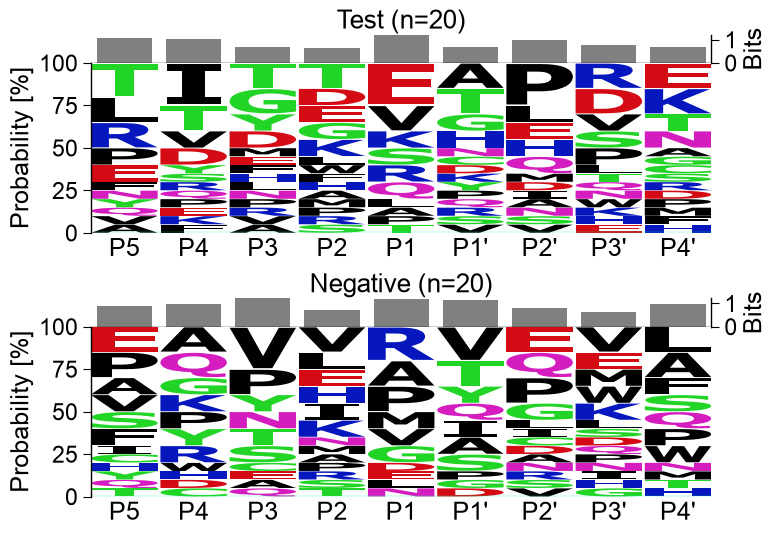
Situation 2 — cross-protein unlabeled windows (``strategy=’different_protein’``) and synthetic controls (``strategy=’synthetic’``).
max_similarity_to_testdrops sampled windows too similar to any test window (anti-leakage);verboseandn_jobsare threaded through:df_diff, _, df_eval_diff = ap.obtain_samples(df_seq, strategy="different_protein", n=20, window_size=9, max_similarity_to_test=0.7, seed=42, verbose=False, n_jobs=1) df_synth, _, _ = ap.obtain_samples(df_seq, strategy="synthetic", n=20, window_size=9, seed=42) aa.display_df(df_eval_diff, n_rows=10, show_shape=True)
DataFrame shape: (1, 6)
n_positive n_negative balance_ratio n_source_proteins protein_coverage max_similarity_to_test 1 20 20 1.000000 15 0.375000 0.333333 Reliable negatives (positive-unlabeled path). Set
reliable_negatives=Trueto refine the cross-protein unlabeled pool into reliable negatives with :class:dPULearn. This path requires a feature setdf_feat(used to build the feature matrixX) andstrategy='different_protein'— it raises a clear error otherwise:df_feat = aa.load_features().head(8) df_rel, _, df_eval_rel = ap.obtain_samples(df_seq, strategy="different_protein", reliable_negatives=True, df_feat=df_feat, n=10, window_size=9, seed=42, n_jobs=1) aa.display_df(df_eval_rel, n_rows=10, show_shape=True)
DataFrame shape: (1, 6)
/Users/stephanbreimann/Programming/1Packages/aa-wt-obtain-samples-logo/aaanalysis/pipe/_obtain_samples.py:134: UserWarning: 4 window(s) lack the flanking residues needed to build the feature matrix and are skipped on the reliable-negatives path; widen the sequences or lower 'window_size' to keep them.
  warnings.warn(f"{n_dropped} window(s) lack the flanking residues needed to build the "
/Users/stephanbreimann/Programming/1Packages/aa-wt-obtain-samples-logo/aaanalysis/feature_engineering/_backend/cpp_run.py:163: UserWarning: CPP is using the Python kernel fallback — the compiled Cython extension is not available in this install. Output is bit-exact with the Cython path but ~2x slower. Reinstall via pip install --force-reinstall aaanalysis to fetch a prebuilt wheel.
  warnings.warn(
n_positive n_negative balance_ratio n_source_proteins protein_coverage max_similarity_to_test 1 20 10 0.500000 7 0.175000 0.333333 Passing
pos_colselects a differently named anchor column. The returneddf_samplesis a'segments'-modedf_seqready to feed the next pipeline (e.g.ap.find_features) — the positives and sampled references carry full provenance in thelabel/role/strategycolumns.