P8: Prediction
Turn a CPP signature into a working, interpretable predictor. The
core case is binary classification (two labelled sets in, a model
that tells you why out); the same pipeline then extends to
multi-class and regression by transforming the labels, with no
change to CPP. This protocol chains the standard AAanalysis pipeline
end-to-end (split each sequence into parts, mine a CPP signature,
assemble a numeric feature matrix, and fit a TreeModel) into a
glass-box predictor whose every input is a human-readable
PART-SPLIT-SCALE feature id tied to an AAontology physicochemical
property.
It is the direct successor to P1: CPP signature: Protocol 1
discovers the determinants that distinguish a test group
(label=1) from a reference group (label=0); here we use
that signature to predict, and rank the features by how hard the model
leans on them.
Interpretable features first, then the simplest model that does the job. Because every CPP feature is a named physicochemical property at a named sequence location, a plain tree ensemble on top of them is already a glass box, and you only believe it once it clearly beats a trivial baseline.
When to use it. Reach for this protocol when you have two labelled
sets of sequences and want a model that not only predicts a new
protein but names the physicochemistry behind the call. In glossary
terms you are moving from determinant discovery (Protocol 1) to
prediction (here, binary classification) with a TreeModel riding
on interpretable CPP features instead of a black box.
We work at the domain level (dataset prefix DOM_): the unit of
comparison is the transmembrane-domain (TMD) part set, CPP’s native
ground. The biological question: given a transmembrane protein, is it a
γ-secretase (GSEC) substrate, and which properties of its TMD and
juxtamembrane (JMD) flanks drive that call? Because every feature is a
position-resolved physicochemical property (an AAontology scale
evaluated at a part and split), the fitted importances name the
determinants: they are not anonymous weights.
When not to use it.
If you only want to know what differs between two groups and have no intention of scoring new proteins, stop at P1: CPP signature: you don’t need a model.
If you have confirmed positives plus a large unlabelled pool but few confirmed negatives, you cannot train a clean binary classifier directly; carve reliable negatives first (see the PU note near the end).
If your goal is a leak-free generalization estimate, the light checks here are not enough: that is P10: Validation.
Three label settings, one pipeline. Most of this protocol builds a
binary classifier; the final section shows the same workflow
reaching multi-class (one-vs-rest / one-vs-one) and regression
(quantile / tiered) tasks by reshaping the labels with
SequenceFeature.get_labels_*. CPP itself stays binary throughout.
Input. The same df_seq that feeds P1: CPP signature: one row
per protein, a binary label column (test group = 1 = substrate,
reference group = 0 = non-substrate), and tmd_start /
tmd_stop boundaries from which the TMD-centric parts are
derived. The default df_parts uses the parts tmd,
jmd_n_tmd_n and tmd_c_jmd_c (the TMD plus its two JMD-flank
composites).
The CPP signature df_feat itself is the output of P1: CPP
signature. To keep this protocol self-contained we re-run the minimal
CPP path here on the bundled DOM_GSEC dataset.
import aaanalysis as aa

aa.options["verbose"] = False
aa.options["random_state"] = 42

# Two labelled sets of sequences (label: 1 = substrate/test, 0 = non-substrate/reference).
# Every public parameter is passed by name, at its default unless stated.
df_seq = aa.load_dataset(name="DOM_GSEC", n=25, random=False, non_canonical_aa="remove",
                         min_len=None, max_len=None, aa_window_size=9, verbose=False)
labels = df_seq["label"].to_list()   # n per class -> 50 proteins (2N rows)
aa.display_df(df=df_seq, n_rows=10, show_shape=True)
DataFrame shape: (50, 9)
| entry | gene | sequence | label | tmd_start | tmd_stop | jmd_n | tmd | jmd_c | |
|---|---|---|---|---|---|---|---|---|---|
| 1 | Q14802 | FXYD3 | MQKVTLGLLVFLAGF...PGETPPLITPGSAQS | 0 | 37 | 59 | NSPFYYDWHS | LQVGGLICAGVLCAMGIIIVMSA | KCKCKFGQKS |
| 2 | Q86UE4 | MTDH | MAARSWQDELAQQAE...SPKQIKKKKKARRET | 0 | 50 | 72 | LGLEPKRYPG | WVILVGTGALGLLLLFLLGYGWA | AACAGARKKR |
| 3 | Q969W9 | PMEPA1 | MHRLMGVNSTAAAAA...AIWSKEKDKQKGHPL | 0 | 41 | 63 | FQSMEITELE | FVQIIIIVVVMMVMVVVITCLLS | HYKLSARSFI |
| 4 | P53801 | PTTG1IP | MAPGVARGPTPYWRL...GLFKEENPYARFENN | 0 | 97 | 119 | RWGVCWVNFE | ALIITMSVVGGTLLLGIAICCCC | CCRRKRSRKP |
| 5 | Q8IUW5 | RELL1 | MAPRALPGSAVLAAA...EVPATPVKRERSGTE | 0 | 59 | 81 | NDTGNGHPEY | IAYALVPVFFIMGLFGVLICHLL | KKKGYRCTTE |
| 6 | P01135 | TGFA | MVPSAGQLALFALGI...LLKGRTACCHSETVV | 0 | 99 | 121 | AVVAASQKKQ | AITALVVVSIVALAVLIITCVLI | HCCQVRKHCE |
| 7 | O43914 | TYROBP | MGGLEPCSRLLLLPL...SDVYSDLNTQRPYYK | 0 | 42 | 64 | DCSCSTVSPG | VLAGIVMGDLVLTVLIALAVYFL | GRLVPRGRGA |
| 8 | P05556 | ITGB1 | MNLQPIFWIGLISSV...KSAVTTVVNPKYEGK | 0 | 729 | 751 | ENPECPTGPD | IIPIVAGVVAGIVLIGLALLLIW | KLLMIIHDRR |
| 9 | P16234 | PDGFRA | MGTSHPAFLVLGCLL...DIGIDSSDLVEDSFL | 0 | 527 | 549 | VAPTLRSELT | VAAAVLVLLVIVIISLIVLVVIW | KQKPRYEIRW |
| 10 | P50895 | BCAM | MEPPDAPAQARGAPR...SGGARGGSGGFGDEC | 0 | 549 | 571 | TVSPQTSQAG | VAVMAVAVSVGLLLLVVAVFYCV | RRKGGPCCRQ |
Run. The real minimal path (no aspirational one-liners). For the
mechanics of each function, see its tutorial (the CPP tutorial for
SequenceFeature and CPP, the TreeModel tutorial for
TreeModel); here we just chain them into a workflow:
Split each sequence into parts with
get_df_parts().Mine the discriminant signature with
CPP(df_parts=...).run(labels=...):CPPtakesdf_parts, notdf_seq/labelsdirectly.Build the numeric feature matrix
Xwithfeature_matrix().Fit the classifier with
TreeModel.fit(X, labels=...)and attach the importance ranking withadd_feat_importance.
# 1) Split each sequence into parts; default df_parts columns are
#    tmd, jmd_n_tmd_n, tmd_c_jmd_c (TMD plus the two JMD-flank composites).
sf = aa.SequenceFeature(verbose=False)
df_parts = sf.get_df_parts(df_seq=df_seq, list_parts=None, all_parts=False,
                           jmd_n_len=10, jmd_c_len=10, tmd_len=None,
                           remove_entries_with_gaps=False, replace_non_canonical_aa=False)

# 2) Mine the most discriminant features (the CPP signature). n_filter caps the
#    signature at 50 features; n_jobs=1 keeps it serial (multiprocessing spawn is
#    fragile on Python 3.14 + macOS without a __main__ guard). Everything else is
#    its default, spelled out so the full public surface is visible.
cpp = aa.CPP(df_parts=df_parts, split_kws=None, df_scales=None, df_cat=None,
             accept_gaps=False, verbose=False, random_state=42,
             bootstrap=False, bootstrap_kws=None)
df_feat = cpp.run(labels=labels, label_test=1, label_ref=0, n_filter=50,
                  n_pre_filter=None, pct_pre_filter=5, max_std_test=0.2,
                  max_overlap=0.5, max_cor=0.5, check_cat=True, parametric=False,
                  start=1, tmd_len=20, jmd_n_len=10, jmd_c_len=10, n_jobs=1,
                  vectorized=True, n_batches=None, n_sample_batches=None,
                  return_stats=False, redundancy="legacy")
aa.display_df(df=df_feat[["feature", "category", "subcategory", "abs_auc", "mean_dif"]],
              n_rows=10, show_shape=True)
DataFrame shape: (50, 5)
| feature | category | subcategory | abs_auc | mean_dif | |
|---|---|---|---|---|---|
| 1 | TMD_C_JMD_C-Pat...,12)-CRAJ730103 | Conformation | β-turn | 0.426000 | -0.266000 |
| 2 | TMD_C_JMD_C-Pat...,12)-BEGF750101 | Conformation | α-helix | 0.419000 | 0.225000 |
| 3 | TMD_C_JMD_C-Pat...,14)-CRAJ730103 | Conformation | β-turn | 0.408000 | -0.312000 |
| 4 | TMD-Pattern(C,4...,11)-BEGF750101 | Conformation | α-helix | 0.396000 | 0.238000 |
| 5 | TMD_C_JMD_C-Pat...,14)-ZIMJ680104 | Energy | Isoelectric point | 0.391000 | 0.129000 |
| 6 | TMD_C_JMD_C-Pat...,14)-ZIMJ680104 | Energy | Isoelectric point | 0.391000 | 0.129000 |
| 7 | TMD-Pattern(C,4...,11)-FUKS010106 | Composition | Membrane proteins (MPs) | 0.390000 | 0.221000 |
| 8 | TMD_C_JMD_C-Pat...4,8)-FUKS010106 | Composition | Membrane proteins (MPs) | 0.390000 | 0.221000 |
| 9 | TMD_C_JMD_C-Seg...4,5)-WOLS870103 | Others | PC 4 | 0.387000 | -0.195000 |
| 10 | TMD_C_JMD_C-Seg...5,7)-FAUJ880104 | Shape | Side chain length | 0.385000 | 0.238000 |
# 3) Build the feature matrix X and fit the interpretable classifier.
#    feature_matrix turns each PART-SPLIT-SCALE feature into one averaged
#    numeric value per protein -> X has shape (n_proteins, n_features).
X = sf.feature_matrix(features=df_feat["feature"], df_parts=df_parts, df_scales=None,
                      accept_gaps=False, n_jobs=1, batch=False, df_seq=None,
                      df_parts_kws=None)

# TreeModel aggregates several tree models over several rounds; .fit sets
# feat_importance, is_selected_ and list_models_ (defaults: n_rounds=5, no RFE).
tm = aa.TreeModel(list_model_classes=None, list_model_kwargs=None, is_preselected=None,
                  verbose=False, random_state=42)
tm = tm.fit(X=X, labels=labels, n_rounds=5, use_rfe=False, n_cv=5, n_feat_min=25,
            n_feat_max=75, metric="accuracy", step=None)

# Attach the Monte-Carlo feature importance (percent) as a column; sort=True
# ranks df_feat most-important-first, so the head shows the top determinants.
df_feat = tm.add_feat_importance(df_feat=df_feat, drop=False, sort=True)
aa.display_df(df=df_feat[["feature", "subcategory", "abs_auc", "mean_dif", "feat_importance"]],
              n_rows=10, show_shape=True)
DataFrame shape: (50, 5)
| feature | subcategory | abs_auc | mean_dif | feat_importance | |
|---|---|---|---|---|---|
| 1 | TMD_C_JMD_C-Pat...,12)-CRAJ730103 | β-turn | 0.426000 | -0.266000 | 5.766000 |
| 2 | TMD_C_JMD_C-Pat...,12)-BEGF750101 | α-helix | 0.419000 | 0.225000 | 4.175000 |
| 3 | TMD-Pattern(C,4...,11)-ROBB760109 | β-turn (N-term) | 0.379000 | -0.151000 | 3.721000 |
| 4 | TMD_C_JMD_C-Pat...,14)-CRAJ730103 | β-turn | 0.408000 | -0.312000 | 3.700000 |
| 5 | TMD_C_JMD_C-Pat...5,8)-ROBB760109 | β-turn (N-term) | 0.379000 | -0.151000 | 3.084000 |
| 6 | TMD_C_JMD_C-Seg...5,7)-FAUJ880104 | Side chain length | 0.385000 | 0.238000 | 2.949000 |
| 7 | TMD_C_JMD_C-Per...4,2)-KOEH090106 | Hydrophilicity | 0.347000 | 0.100000 | 2.939000 |
| 8 | TMD_C_JMD_C-Pat...4,8)-FUKS010106 | Membrane proteins (MPs) | 0.390000 | 0.221000 | 2.745000 |
| 9 | TMD-Pattern(C,4...,11)-FUKS010106 | Membrane proteins (MPs) | 0.390000 | 0.221000 | 2.723000 |
| 10 | TMD_C_JMD_C-Pat...,12)-MUNV940101 | Free energy (folding) | 0.383000 | -0.119000 | 2.647000 |
Output. A few things came out of that run:
a fitted :class:`~aaanalysis.TreeModel` carrying
feat_importance/feat_importance_std(group-level importance, percent),is_selected_(per-round selection) andlist_models_(the fitted estimators);an enriched ``df_feat``, the CPP signature plus a
feat_importancecolumn, so each determinant is ranked;a ``df_eval`` row of cross-validated metric means (below);
per-protein substrate probabilities with a Monte-Carlo spread.
The quickest way to see the classifier is the CPP ranking plot:
the top determinants, how strongly each separates the two groups
(mean_dif, left), and how hard the model leans on each
(feat_importance, gray). This is the protocol’s key figure: it reads
as a ranked list of named physicochemical determinants, not anonymous
weights.
import matplotlib.pyplot as plt

# Key figure: the top determinants the fitted classifier relies on.
# Left subplot = group difference (mean_dif); gray bars = group-level feat_importance.
cpp_plot = aa.CPPPlot(df_scales=None, df_cat=None, jmd_n_len=10, jmd_c_len=10,
                      accept_gaps=False, verbose=False)
fig, axes = cpp_plot.ranking(df_feat=df_feat, shap_plot=False, col_dif="mean_dif",
                             col_imp="feat_importance", rank=True, n_top=15,
                             figsize=None, tmd_len=20, tmd_jmd_space=2,
                             tmd_color="mediumspringgreen", jmd_color="blue",
                             tmd_jmd_alpha=0.075, name_test="Substrate",
                             name_ref="Non-substrate", fontsize_titles=12,
                             fontsize_labels=12, fontsize_annotations=11,
                             xlim_dif=(-17.5, 17.5), xlim_rank=(0, 4),
                             rank_info_xy=None, sample=None)
plt.tight_layout()
plt.show()
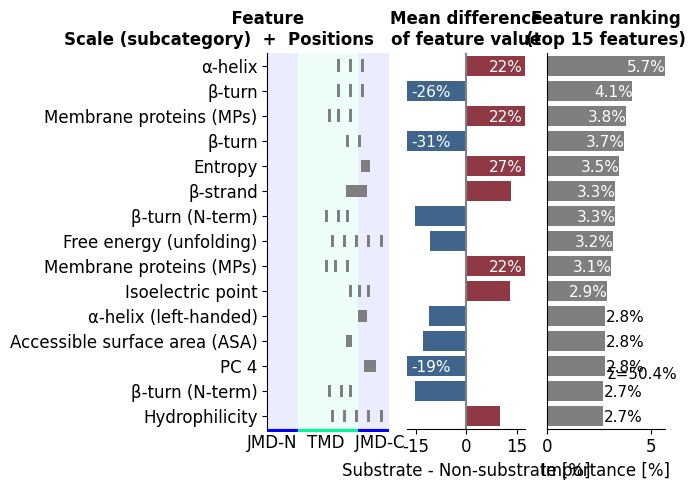
Notice how the top bars are TMD/JMD physicochemical patterns, named
PART-SPLIT-SCALE determinants, not anonymous weights. In the
rendered plot, the left panel shows each feature’s mean_dif (which
way it points: bars to the right sit higher in substrates, bars to the
left higher in non-substrates), while the gray feat_importance bars
on the right show how hard the fitted model leans on each one. Read the
two together: bar height (gray) tells you how much a determinant
matters, and mean_dif direction (left) tells you which way.
Honest evaluation hooks (light). A figure shows what the model leans on; these three quick checks tell you whether it is non-trivial. They are not a substitute for validation:
Cross-validated metrics via
eval()over the fitted feature set (fitran withuse_rfe=False, so all features are kept).A trivial baseline, a majority-class
DummyClassifier; a real model must beat its ~0.5 balanced accuracy.Per-protein probabilities via
predict_proba()(a mean score and its Monte-Carlo std).
Read these numbers as an optimistic upper bound, not an unbiased
estimate. The CPP signature was mined with labels on the whole
50-protein dataset, then this CV reuses exactly those globally-selected
feature columns, so each fold’s features were chosen using proteins that
also sit in that fold’s test split (feature-selection leakage). It is a
sanity check / ceiling, not a generalization estimate, and the figure
below measures how much of that ceiling is leakage. Leak-free nested or
hold-out evaluation plus shuffled-label controls live in P10:
Validation.
To actually reduce the feature set (recursive feature elimination)
rather than keep all features, fit with
TreeModel(...).fit(X, labels, use_rfe=True) or call
select_features; is_selected_ then marks the retained subset.
# Cross-validated performance of the full fitted feature set (use_rfe=False
# keeps all features; is_selected_ is all-True). Optimistic: the CPP features
# were selected on the full dataset, so this is an upper bound, not a clean
# generalization estimate (the next figure measures the size of that bound).
df_eval = tm.eval(X=X,
                  labels=labels,
                  list_is_selected=[tm.is_selected_],
                  convert_1d_to_2d=False,
                  names_feature_selections=None,
                  n_cv=5,
                  list_metrics=["accuracy", "balanced_accuracy", "f1", "roc_auc"])

# Trivial majority-class baseline for comparison (~0.5 balanced accuracy).
from sklearn.dummy import DummyClassifier
from sklearn.model_selection import cross_val_score

baseline_bacc = cross_val_score(
    DummyClassifier(strategy="most_frequent"),
    X, labels, cv=5, scoring="balanced_accuracy").mean()

aa.display_df(df=df_eval.assign(baseline_balanced_accuracy=round(float(baseline_bacc), 3)),
              n_rows=10, show_shape=True)
DataFrame shape: (1, 6)
| name | accuracy | balanced_accuracy | f1 | roc_auc | baseline_balanced_accuracy | |
|---|---|---|---|---|---|---|
| 1 | Set 1 | 0.920000 | 0.920000 | 0.925300 | 0.984000 | 0.500000 |
Scikit-learn native. The cross-validation above runs a stock
sklearn estimator straight on X, with no adapter and no wrapper.
Because feature_matrix() returns a plain numeric
matrix X (one column per feature), CPP features compose with any
scikit-learn estimator, Pipeline, or cross-validator. For example,
to standardise then classify in one object:
from sklearn.pipeline import Pipeline
from sklearn.preprocessing import StandardScaler
from sklearn.ensemble import RandomForestClassifier

pipe = Pipeline([("scaler", StandardScaler()),
                 ("clf", RandomForestClassifier(random_state=42))])
pipe.fit(X, labels)                       # X = SequenceFeature.feature_matrix(...)
The same caveat as the light eval above applies: this fixes the feature
set selected once up front, so a cross_val_score on it scores the
model, not the selection. For a leak-free estimate that
reselects features inside each fold, see P10: Validation.
# Per-protein predicted probability of being a substrate (requires prior fit).
import pandas as pd

pred, pred_std = tm.predict_proba(X=X)
df_pred = pd.DataFrame({
    "entry": df_seq["entry"].to_list(),
    "label": labels,
    "p_substrate": pred.round(3),
    "p_std": pred_std.round(3),
})
# These are IN-SAMPLE (training) predictions, shown only to demonstrate the
# output shape -- they say nothing about generalization. p_std is the spread
# across the ensemble (all tree models over all rounds), i.e. agreement, NOT
# held-out confidence: a small p_std means the models concur, not that the call
# is correct on unseen data. Score real, unseen proteins to judge generalization.
aa.display_df(df=df_pred.sort_values("p_substrate", ascending=False),
              n_rows=10, show_shape=True)
DataFrame shape: (50, 4)
| entry | label | p_substrate | p_std | |
|---|---|---|---|---|
| 33 | P09803 | 1 | 1.000000 | 0.000000 |
| 34 | P19022 | 1 | 1.000000 | 0.000000 |
| 30 | Q06481 | 1 | 0.999000 | 0.002000 |
| 44 | Q9ERC8 | 1 | 0.999000 | 0.002000 |
| 36 | P09603 | 1 | 0.992000 | 0.005000 |
| 35 | P16070 | 1 | 0.991000 | 0.005000 |
| 42 | Q63155 | 1 | 0.986000 | 0.004000 |
| 46 | Q15303 | 1 | 0.984000 | 0.006000 |
| 45 | P54763 | 1 | 0.984000 | 0.002000 |
| 31 | P35613 | 1 | 0.980000 | 0.003000 |
The hook, shown. That caveat is measurable, so the next two cells
measure it. One set of five stratified folds is fixed, and the same
TreeModel is scored over those same folds three times, changing only
where its features come from:
Trivial baseline: a majority-class
DummyClassifier, the floor any real model has to clear.Leak-free:
run()is re-mined inside each training fold, and the held-out proteins are scored with the ids that fold selected. Because CPP feature ids are dataset-independent strings, onefeature_matrix()call builds the training matrix and a second one builds the test matrix from the very same ids.Optimistic: the globally mined
Xfrom the top of this protocol, the same matrixeval()just scored.
Folds, estimator and random_state are held fixed across the three
arms, so the distance between the last two is the feature-selection
leakage and nothing else.
import numpy as np
from sklearn.metrics import balanced_accuracy_score
from sklearn.model_selection import StratifiedKFold

# One fixed fold structure, shared by all three arms.
y = np.asarray(labels)
skf = StratifiedKFold(n_splits=5, shuffle=True, random_state=42)
scores = {"Trivial baseline": [], "Leak-free": [], "Optimistic": []}

for train_idx, test_idx in skf.split(X, y):
    # (a) trivial baseline: always predict the majority class of the training fold
    dummy = DummyClassifier(strategy="most_frequent").fit(X[train_idx], y[train_idx])
    scores["Trivial baseline"].append(
        balanced_accuracy_score(y[test_idx], dummy.predict(X[test_idx])))

    # (b) leak-free: re-mine the CPP signature on the TRAINING proteins only, then
    #     score the held-out proteins with that fold's feature ids.
    df_parts_train, df_parts_test = df_parts.iloc[train_idx], df_parts.iloc[test_idx]
    cpp = aa.CPP(df_parts=df_parts_train)
    df_feat_fold = cpp.run(labels=y[train_idx], n_filter=50, n_jobs=1)
    X_train = sf.feature_matrix(features=df_feat_fold["feature"], df_parts=df_parts_train,
                                n_jobs=1)
    X_test = sf.feature_matrix(features=df_feat_fold["feature"], df_parts=df_parts_test,
                               n_jobs=1)
    tm = aa.TreeModel(verbose=False, random_state=42).fit(X=X_train, labels=y[train_idx])
    proba, _ = tm.predict_proba(X=X_test)
    scores["Leak-free"].append(
        balanced_accuracy_score(y[test_idx], (proba >= 0.5).astype(int)))

    # (c) optimistic: the globally mined X, same folds, same estimator
    tm = aa.TreeModel(verbose=False, random_state=42).fit(X=X[train_idx], labels=y[train_idx])
    proba, _ = tm.predict_proba(X=X[test_idx])
    scores["Optimistic"].append(
        balanced_accuracy_score(y[test_idx], (proba >= 0.5).astype(int)))

df_honest = pd.DataFrame({
    "arm": list(scores),
    "balanced_accuracy": [round(float(np.mean(v)), 3) for v in scores.values()],
    "per_fold": [", ".join(f"{s:.2f}" for s in v) for v in scores.values()],
})
aa.display_df(df=df_honest, n_rows=10, show_shape=True)
DataFrame shape: (3, 3)
| arm | balanced_accuracy | per_fold | |
|---|---|---|---|
| 1 | Trivial baseline | 0.500000 | 0.50, 0.50, 0.50, 0.50, 0.50 |
| 2 | Leak-free | 0.840000 | 0.90, 0.70, 1.00, 0.80, 0.80 |
| 3 | Optimistic | 0.940000 | 1.00, 0.90, 1.00, 1.00, 0.80 |
import seaborn as sns

# The three arms over the same folds. The solid part of the optimistic bar is the
# leak-free number; its hatched overhang is what feature-selection leakage adds.
means = {k: float(np.mean(v)) for k, v in scores.items()}
honest, optimistic = means["Leak-free"], means["Optimistic"]
colors = ["#7F7F7F", "tab:green", "tab:red"]
arms = ["Trivial baseline\n(majority class)",
        "Leak-free\n(features re-mined per fold)",
        "Optimistic\n(features mined once, on all data)"]

aa.plot_settings(font_scale=0.85, weight_bold=False, short_ticks=True)
fig, ax = plt.subplots(figsize=(7.8, 3.0))
ypos = np.arange(3)[::-1]
ax.barh(ypos, [means["Trivial baseline"], honest, honest], color=colors, height=0.5,
        edgecolor="white", zorder=3)
ax.barh(ypos[2], optimistic - honest, left=honest, color="white", height=0.5,
        edgecolor=colors[2], hatch="///", linewidth=1.0, zorder=3)
for yp, vals in zip(ypos, scores.values()):
    ax.scatter(vals, np.full(len(vals), yp), color="black", s=11, zorder=5, alpha=0.55)
for yp, m in zip(ypos, means.values()):
    ax.text(0.03, yp, f"{m:.2f}", va="center", ha="left", color="white",
            size=aa.plot_gcfs(), zorder=6)
ax.text(optimistic + 0.02, ypos[2], f"+{optimistic - honest:.2f} leakage",
        va="center", ha="left", size=aa.plot_gcfs() - 2)
ax.axvline(0.5, color="black", ls="--", lw=1, zorder=4)
ax.set_yticks(ypos)
ax.set_yticklabels(arms)
ax.set_ylim(-0.55, 2.55)
ax.set_xlim(0, 1.45)
ax.set_xticks([0, 0.25, 0.5, 0.75, 1.0])
ax.set_xlabel("Balanced accuracy (same 5 folds)")
ax.set_title("Feature-selection leakage, measured", size=aa.plot_gcfs() + 1, loc="left")
sns.despine()
plt.tight_layout()
plt.show()

Reading it: both model arms clear the dashed 0.50 baseline by a wide margin, which is the check that actually matters here, so the TMD/JMD physicochemistry is plausibly discriminative. The hatched overhang is the rest of the story: it is balanced accuracy that the globally mined signature was borrowing from proteins sitting in its own test folds, and a protein the pipeline has never seen will not honour it. The black dots are the five per-fold values, and their spread on a 50-protein fixture is the second reason to read any single number as provisional. Note also that the leak-free arm is still not a clean generalization estimate: only the features were re-mined per fold, while the dataset, the parts and the split settings were fixed once up front. Doing this properly, with a shuffled-label control that proves the pipeline cannot learn noise, is P10: Validation.
How to interpret.
Output |
Non-expert reading |
|---|---|
|
the selected TMD/JMD physicochemistry is plausibly discriminative, confirm with leak-free validation in P10: Validation (this light CV is an optimistic upper bound) |
high |
the model ranks substrates above non-substrates reliably |
high |
the determinant the model leans on most for the call |
sign of |
direction of the effect (positive = property higher in substrates) |
|
a substrate (or non-substrate) call; in-sample here, so judge confidence only on unseen proteins |
large |
an unstable prediction (the ensemble models disagree) |
feat_importance is unsigned (magnitude of influence only).
Always pair it with mean_dif from the CPP signature to recover
the biological direction, e.g. higher side-chain volume in the TMD
core rather than just side-chain volume matters.
Key takeaways
The classifier is a glass box: each input is a named
PART-SPLIT-SCALEdeterminant, so a tallfeat_importancebar points at a concrete physicochemical property at a concrete sequence location, read with the sign ofmean_diffor direction.A model is only worth interpreting once it clearly beats the ~0.5 baseline; here balanced accuracy sits well above it.
These numbers are an optimistic ceiling, and the leakage figure above puts a number on it: re-mining the signature inside each fold costs balanced accuracy, and what it costs is exactly what a globally mined signature was quietly borrowing from the test folds. Treat the result as “plausibly discriminative” and defer real trust to P10: Validation.
Common mistakes.
``CPP(df_seq=…)`` / ``CPP().run(df_seq, labels)``:
CPPtakesdf_parts; build them withget_df_parts()first.Skipping the feature matrix:
fit()needs numericXfromfeature_matrix(), notdf_featordf_seq.Reading ``feat_importance`` as signed: it is magnitude only; combine with
mean_diffor direction.Calling ``predict_proba`` or ``add_feat_importance`` before ``fit``: both rely on attributes set during
.fit.Mistaking light eval for validation: the CV row and baseline here are sanity checks; rigorous trust-building is P10: Validation.
Mis-using :class:`~aaanalysis.dPULearn`: it expects labels 1 (positive) and 2 (unlabelled), not 0/1, and
n_unl_to_negmust be >= 1 and must not exceed the number of unlabelled samples.
PU note: when confirmed negatives are scarce. Real GSEC datasets often have confirmed substrates (positives, label 1) but few confirmed non-substrates; the rest are unlabelled (label 2). You cannot train a clean binary classifier on positives-plus-unlabelled directly.
dPULearn (core, no pro dependency) solves the first half: from the
unlabelled pool it identifies reliable negatives (label 0), the
proteins most dissimilar from the positives in CPP feature space, which
you can then feed to the classifier above. See the dPULearn tutorial for
the method details.
Because CPP feature identifiers are dataset-independent strings, the
same df_feat["feature"] builds the feature matrix for the PU
proteins. We demonstrate on the bundled DOM_GSEC_PU dataset, then
visualize the carve with the canonical dPULearn PCA: positives, the
newly carved reliable negatives, and the still-unlabelled pool laid out
in the first two principal components of CPP feature space.
# Positives (1) + unlabelled (2): n=20 -> 20 positives and 20 unlabelled.
df_seq_pu = aa.load_dataset(name="DOM_GSEC_PU", n=20, random=False,
                            non_canonical_aa="remove", min_len=None, max_len=None,
                            aa_window_size=9, verbose=False)
labels_pu = df_seq_pu["label"].to_list()

# Reuse the SAME CPP feature ids to build X for the PU proteins.
df_parts_pu = sf.get_df_parts(df_seq=df_seq_pu, list_parts=None, all_parts=False,
                              jmd_n_len=10, jmd_c_len=10, tmd_len=None,
                              remove_entries_with_gaps=False,
                              replace_non_canonical_aa=False)
X_pu = sf.feature_matrix(features=df_feat["feature"], df_parts=df_parts_pu,
                         df_scales=None, accept_gaps=False, n_jobs=1, batch=False,
                         df_seq=None, df_parts_kws=None)

# Carve reliable negatives (0) from the unlabelled pool (2).
# n_unl_to_neg must be >= 1 and must not exceed the number of unlabelled samples (<= 20 here).
# n_components=5 keeps several leading PCs so the carve is visualizable as a PC1-vs-PC2 PCA.
dpul = aa.dPULearn(model_kwargs=None, verbose=False, random_state=42)
dpul = dpul.fit(X=X_pu, labels=labels_pu, X_pos=None, X_unlabeled=None, label_pos=1,
                label_unl=2, label_neg=None, n_neg=None, n_unl_to_neg=10, metric=None,
                n_components=5)

# labels_: 1 = positive, 0 = newly identified reliable negative, 2 = still unlabelled.
df_carve = pd.DataFrame({
    "label": [1, 0, 2],
    "meaning": ["positive", "carved reliable negative", "still unlabelled"],
    "n": [int((dpul.labels_ == v).sum()) for v in (1, 0, 2)],
})
aa.display_df(df=df_carve, n_rows=10, show_shape=True)
DataFrame shape: (3, 3)
| label | meaning | n | |
|---|---|---|---|
| 1 | 1 | positive | 20 |
| 2 | 0 | carved reliable negative | 10 |
| 3 | 2 | still unlabelled | 10 |
# Headline figure: the dPULearn PCA. The PU proteins are projected into the
# first two principal components of CPP feature space. Dashed lines mark the
# positive-class mean per PC; the unlabelled points (2) furthest from it are
# carved as reliable negatives (0), which then feed the classifier above.
df_pu = dpul.df_pu_
labels_carved = dpul.labels_

aa.plot_settings(font_scale=0.8)
dpul_plot = aa.dPULearnPlot()
dpul_plot.pca(df_pu=df_pu, labels=labels_carved, figsize=(5, 5), pc_x=1, pc_y=2,
              show_pos_mean_x=True, show_pos_mean_y=True, colors=None, names=None,
              df_pu_add=None, names_add=None, colors_add=None, legend=True,
              legend_y=-0.15, kwargs_scatterplot=None)
plt.tight_layout()
plt.show()

Beyond binary: multi-class and regression. CPP never becomes
multi-class or regression-aware. Instead you decompose the harder task
into a set of binary contrasts with the SequenceFeature.get_labels_*
helpers, then loop the same run() (and, if you want a predictor,
the same TreeModel) over them. The contrast you build, not a change
to CPP, is what adapts the workflow. We reuse the df_parts and
feature matrix X from the binary run above. Each helper builds its
own set of binary contrasts, and the figure closing this section draws
all of them on one axis, so the three settings are comparable at a
glance.
Multi-class (build the classes). DOM_GSEC is binary, so we
manufacture a three-class problem the way you would split a
heterogeneous group into sub-types: cluster the substrates into two
physicochemical groups with AAclust (clustered on the CPP feature
matrix X, so the sub-types are physicochemically meaningful),
keeping the non-substrates as the third class.
import numpy as np
from sklearn.cluster import KMeans

# Cluster substrates (label 1) into two sub-types on the CPP feature matrix;
# non-substrates (label 0) stay as the third class.
sub_mask = np.array(labels) == 1
aac = aa.AAclust(model_class=KMeans, model_kwargs=None, verbose=False, random_state=42)
aac.fit(X=X[sub_mask], n_clusters=2, on_center=True, min_th=0.3, merge=True,
        metric="euclidean", names=None)
sub_clusters = np.asarray(aac.labels_)          # 0 / 1 per substrate

multiclass = np.zeros(len(labels), dtype=int)   # class 0 = non-substrates
multiclass[sub_mask] = sub_clusters + 1         # class 1, 2 = substrate sub-types

df_classes = pd.DataFrame({
    "class": [0, 1, 2],
    "meaning": ["non-substrate", "substrate sub-type A", "substrate sub-type B"],
    "n": [int((multiclass == c).sum()) for c in (0, 1, 2)],
})
aa.display_df(df=df_classes, n_rows=10, show_shape=True)
DataFrame shape: (3, 3)
| class | meaning | n | |
|---|---|---|---|
| 1 | 0 | non-substrate | 25 |
| 2 | 1 | substrate sub-type A | 15 |
| 3 | 2 | substrate sub-type B | 10 |
One-vs-rest (OvR). get_labels_ovr turns the three classes into
three full-length binary arrays: each class in turn is the test group,
everything else the reference. No samples are dropped, so all three
reuse the same df_parts; loop run() once per class to read
each class’s own signature.
# One-vs-rest: each class becomes the test group (1) vs all others (0).
dict_ovr = sf.get_labels_ovr(labels=multiclass, label_test=1, label_ref=0)
rows = []
for cls, y_ovr in dict_ovr.items():
    cpp = aa.CPP(df_parts=df_parts)
    df_f = cpp.run(labels=y_ovr, n_filter=10, n_jobs=1)
    top = df_f.iloc[0]
    rows.append({"class": int(cls), "n_test": int((y_ovr == 1).sum()),
                 "top_feature": top["feature"], "top_abs_auc": round(float(top["abs_auc"]), 3)})
aa.display_df(df=pd.DataFrame(rows), n_rows=10, show_shape=True)
DataFrame shape: (3, 4)
| class | n_test | top_feature | top_abs_auc | |
|---|---|---|---|---|
| 1 | 0 | 25 | TMD_C_JMD_C-Pat...,12)-CRAJ730103 | 0.426000 |
| 2 | 1 | 15 | TMD_C_JMD_C-Seg...6,9)-VHEG790101 | 0.476000 |
| 3 | 2 | 10 | TMD_C_JMD_C-Pat...,15)-OOBM850101 | 0.416000 |
One-vs-one (OvO). get_labels_ovo compares each pair of
classes, discarding the others. Because samples are dropped, it returns
per pair the row-matched df_parts copy alongside the labels (pass
dict_num_parts instead for run_num()), so each pair feeds
run() directly with no manual masking.
# One-vs-one: each class pair, other classes discarded. The helper subsets
# df_parts for us and returns the row-matched copy.
res_ovo = sf.get_labels_ovo(labels=multiclass, df_parts=df_parts, dict_num_parts=None,
                            label_test=1, label_ref=0)
rows = []
for (a, b), (df_pair, _, y_pair) in res_ovo.items():
    cpp = aa.CPP(df_parts=df_pair)
    df_f = cpp.run(labels=y_pair, n_filter=10, n_jobs=1)
    top = df_f.iloc[0]
    rows.append({"pair": f"{a} vs {b}", "n": int(len(df_pair)),
                 "top_feature": top["feature"], "top_abs_auc": round(float(top["abs_auc"]), 3)})
aa.display_df(df=pd.DataFrame(rows), n_rows=10, show_shape=True)
DataFrame shape: (3, 4)
| pair | n | top_feature | top_abs_auc | |
|---|---|---|---|---|
| 1 | 0 vs 1 | 40 | TMD_C_JMD_C-Seg...3,4)-EISD860102 | 0.484000 |
| 2 | 0 vs 2 | 35 | TMD_C_JMD_C-Pat...,14)-TANS770110 | 0.472000 |
| 3 | 1 vs 2 | 25 | TMD_C_JMD_C-Seg...4,6)-RACS820101 | 0.500000 |
Regression (continuous target). For a continuous score CPP still
needs two groups, so we cut the score into a contrast. Here we attach a
random cleavage-efficiency value to each substrate (replace with
real measurements in practice) and turn it into labels two ways:
get_labels_quantile for a single high-vs-low split, and
get_labels_tiered for a fixed high-efficiency positive set compared
against progressively stricter low-efficiency negatives (the middle band
dropped per tier, with the row-matched df_parts returned).
# Continuous target: random cleavage efficiency per substrate (placeholder).
rng = np.random.default_rng(42)
df_parts_sub = df_parts[sub_mask]
efficiency = rng.uniform(0.0, 1.0, size=int(sub_mask.sum()))

# Single quantile cut: high (>= median) vs low efficiency (no samples dropped).
y_q = sf.get_labels_quantile(targets=efficiency, q=0.5, label_test=1, label_ref=0)
cpp = aa.CPP(df_parts=df_parts_sub)
df_feat_q = cpp.run(labels=y_q, n_filter=15, n_jobs=1)

# Tiered: fixed high-efficiency positives vs progressively stricter negatives.
res_tier = sf.get_labels_tiered(targets=efficiency, q_pos=0.7, list_q_neg=[0.5, 0.3],
                                df_parts=df_parts_sub, dict_num_parts=None,
                                label_test=1, label_ref=0)
rows = [{"contrast": "quantile q=0.5", "n_samples": int(len(df_parts_sub)),
         "top_feature": df_feat_q.iloc[0]["feature"]}]
for q_neg, (df_tier, _, y_tier) in res_tier.items():
    cpp = aa.CPP(df_parts=df_tier)
    df_f = cpp.run(labels=y_tier, n_filter=10, n_jobs=1)
    rows.append({"contrast": f"tiered q_neg={q_neg}", "n_samples": int(len(df_tier)),
                 "top_feature": df_f.iloc[0]["feature"]})
aa.display_df(df=pd.DataFrame(rows), n_rows=10, show_shape=True)
DataFrame shape: (3, 3)
| contrast | n_samples | top_feature | |
|---|---|---|---|
| 1 | quantile q=0.5 | 25 | TMD-PeriodicPat...4,2)-NAKH900113 |
| 2 | tiered q_neg=0.5 | 21 | TMD-Pattern(C,3...,13)-JANJ790101 |
| 3 | tiered q_neg=0.3 | 16 | TMD-Pattern(N,8...,15)-QIAN880138 |
The three settings in one picture. Binary, multi-class and
regression look like three different tasks, but by the time they reach
run() they are the same object: one labels array holding a
test group and a reference group. What the three settings really
decide is which proteins land in which group, and which are dropped from
the contrast altogether. The figure below draws exactly that, one bar
per contrast built in this section, so the settings can be compared as a
family instead of read one cell at a time.
# Collect the composition of every contrast built above: how many proteins are
# the test group, the reference group, and how many the helper dropped.
n_total, n_sub = len(labels), len(df_parts_sub)
name_bin = "Binary: the labels as given"
name_mc = "Multi-class: one label per class"
name_reg = "Regression: a cut through a continuous score"

rows = [(name_bin, "substrate vs non-substrate",
         int((y == 1).sum()), int((y == 0).sum()), 0)]
for cls, y_ovr in dict_ovr.items():
    rows.append((name_mc, f"OvR: class {cls}", int((y_ovr == 1).sum()),
                 int((y_ovr == 0).sum()), n_total - len(y_ovr)))
for (a, b), (df_pair, _, y_pair) in res_ovo.items():
    rows.append((name_mc, f"OvO: {a} vs {b}", int((y_pair == 1).sum()),
                 int((y_pair == 0).sum()), n_total - len(y_pair)))
rows.append((name_reg, "quantile q=0.5", int((y_q == 1).sum()),
             int((y_q == 0).sum()), n_sub - len(y_q)))
for q_neg, (df_tier, _, y_tier) in res_tier.items():
    rows.append((name_reg, f"tiered q_neg={q_neg}", int((y_tier == 1).sum()),
                 int((y_tier == 0).sum()), n_sub - len(y_tier)))

df_contrasts = pd.DataFrame(rows, columns=["setting", "contrast", "n_test", "n_ref",
                                           "n_dropped"])
aa.display_df(df=df_contrasts, n_rows=10, show_shape=True)
DataFrame shape: (10, 5)
| setting | contrast | n_test | n_ref | n_dropped | |
|---|---|---|---|---|---|
| 1 | Binary: the labels as given | substrate vs non-substrate | 25 | 25 | 0 |
| 2 | Multi-class: on...label per class | OvR: class 0 | 25 | 25 | 0 |
| 3 | Multi-class: on...label per class | OvR: class 1 | 15 | 35 | 0 |
| 4 | Multi-class: on...label per class | OvR: class 2 | 10 | 40 | 0 |
| 5 | Multi-class: on...label per class | OvO: 0 vs 1 | 25 | 15 | 10 |
| 6 | Multi-class: on...label per class | OvO: 0 vs 2 | 25 | 10 | 15 |
| 7 | Multi-class: on...label per class | OvO: 1 vs 2 | 15 | 10 | 25 |
| 8 | Regression: a c...ontinuous score | quantile q=0.5 | 13 | 12 | 0 |
| 9 | Regression: a c...ontinuous score | tiered q_neg=0.5 | 8 | 13 | 4 |
| 10 | Regression: a c...ontinuous score | tiered q_neg=0.3 | 8 | 8 | 9 |
# One bar per contrast: test group, reference group, and the proteins dropped.
# The regression rows are shorter because they are drawn from the 25 substrates only.
dict_color = aa.plot_get_cdict(name="DICT_COLOR")
c_test, c_ref, c_drop = dict_color["FEAT_POS"], dict_color["FEAT_NEG"], "lightgray"
settings = df_contrasts["setting"].unique().tolist()

aa.plot_settings(font_scale=0.85, weight_bold=False, short_ticks=True)
fig, axes = plt.subplots(3, 1, figsize=(7.4, 4.8), sharex=True,
                         gridspec_kw={"height_ratios":
                                      [int((df_contrasts["setting"] == s).sum())
                                       for s in settings]})
for ax, setting in zip(axes, settings):
    df_s = df_contrasts[df_contrasts["setting"] == setting]
    ypos = np.arange(len(df_s))[::-1]
    n_test = df_s["n_test"].to_numpy()
    n_ref = df_s["n_ref"].to_numpy()
    n_drop = df_s["n_dropped"].to_numpy()
    ax.barh(ypos, n_test, color=c_test, height=0.6, edgecolor="white", zorder=3)
    ax.barh(ypos, n_ref, left=n_test, color=c_ref, height=0.6, edgecolor="white", zorder=3)
    ax.barh(ypos, n_drop, left=n_test + n_ref, color=c_drop, height=0.6,
            edgecolor="white", hatch="//", zorder=3)
    ax.set_yticks(ypos)
    ax.set_yticklabels(df_s["contrast"].to_list())
    ax.set_ylim(-0.6, len(df_s) - 0.4)
    ax.set_title(setting, size=aa.plot_gcfs(), loc="left")
    ax.set_xlim(0, 51)
axes[-1].set_xlabel("Proteins in the contrast")
sns.despine()
aa.plot_legend(ax=axes[-1], dict_color={"test (1)": c_test, "reference (0)": c_ref,
                                        "dropped": c_drop},
               n_cols=3, loc="upper center", y=-0.85, marker="s", marker_size=13)
plt.tight_layout()
plt.show()

Reading it: the binary row is the whole dataset, 25 against 25.
One-vs-rest keeps all 50 proteins and only moves the boundary, so class
2 arrives at CPP as a 10-versus-40 contrast that is harder than class
0’s balanced one. One-vs-one and the two tiered contrasts carry a grey
block: those proteins are dropped, which is precisely why both helpers
hand back the row-matched df_parts instead of leaving you to mask it
by hand. The regression bars are shorter than the multi-class bars
because they are drawn from the 25 substrates only, the subset the
continuous score is defined on.
Each contrast yields its own CPP signature that you read exactly as
the binary one (and can feed to TreeModel for a per-contrast
predictor). Key takeaways: CPP stays binary, and the figure above is
that claim in one picture: whichever setting you pick, what reaches
run() is a single test-versus-reference split. get_labels_*
turns a harder task into those binary contrasts. OvR and quantile keep
all samples (shared df_parts); OvO and tiered drop samples (the grey
blocks) and hand back the matching df_parts subset, so there is
never a mask to apply by hand.
Next step. To explain a single prediction down to per-sample,
single-residue contributions (ShapModel, sample-level
feature_map()), continue to P9: Interpretability; for
leak-free evaluation of any of these contrasts, see P10: Validation.